Māori Data Sovereignty and the Fragility of Borrowed AI
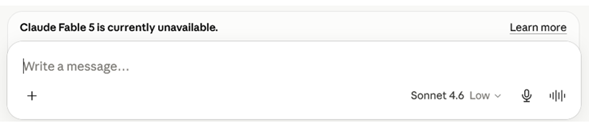
Anthropic the company behind the Claude AI received with no warning or explanation, a directive directing them to immediately suspend access to their Fable 5 and Mythos 5 models for all foreign nationals in America and all non-Americans on the planet, . This included New Zealand who had access for several days prior.
“Fable 5 and Mythos 5 are advanced AI models released by Anthropic, with Mythos 5 representing the most capable frontier model in Anthropic’s lineup at the time. Anthropic instituted strong safeguards designed to greatly reduce the likelihood that Fable could be misused for tasks related to cybersecurity, and worked with the US government, UK AI Safety Institute, and third-party organizations to red-team these safeguards for thousands of hours before launch. As of June 12, 2026, the US government issued an export control directive citing national security concerns, requiring Anthropic to suspend all access to both models for any foreign national worldwide, while access to Anthropic’s other models remains unaffected. (Claude.ai – Prompt “In a paragraph what is Fable 5 and Mythos 5”
Hundreds of millions of users outside the United States lost access overnight because a foreign government decided to issue a directive to stop their access. This could have been any American owned tech company and any service that the New Zealand government and many New Zealand businesses are fully reliable upon. In this instance, it was a part of an advanced AI in Claude that will cause some, but not catastrophic damage to New Zealand government, businesses and citizens.
It is important to note that this was not a New Zealand government decision, but an American government decision that impacts all non-American citizens in both America and all over the globe. It is also not known at this stage how many New Zealand companies and government organisations lost Intellectual Property due to this decision.
This is a recent and international proof of concept for digital colonialism that I have spoken about for years. The clearest real world demonstration yet that AI capability is a US-controlled resource that can be switched off for the rest of the world without notice, justification, or recourse. This is the structural power asymmetry that makes access to AI services categorically different from sovereignty over AI. New Zealand like every other non-US nation had zero input into this decision and zero ability to protect its users, businesses, or government services.
This also reinforces the argument and makes it concrete proof that the widespread fist of The CLOUD Act can, and just did, impacting the globe including every New Zealand citizen, Māori and non-Māori.
It distinguishes data residency from genuine sovereignty, with The CLOUD Act and changing geo-political uncertainty as key examples of how US law reaches into nominally “local” infrastructure. This directive extends that logic to the capability layer itself: it’s not just that US law can compel access to data stored overseas, but that US national security authorities can unilaterally revoke the tools themselves. Sovereignty that depends on a foreign government’s forbearance is not sovereignty.
For years I have been saying (this term is becoming my TradeMark saying) that New Zealand and Māori in particular cannot afford to treat access to overseas AI platforms as equivalent to sovereignty over AI. Tino rangatiratanga, the authority guaranteed to Māori under Te Tiriti o Waitangi, cannot be exercised over tools that a foreign state can revoke at will.
Considering this in light of how dependent our own government already is on American owned big tech. Microsoft Copilot is the default AI tool across much of the New Zealand public sector. Government departments, the same departments that hold whakapapa records, health data, justice information, and social welfare data on Māori are running, almost totally according to my 2025 Māori Data Governance Report on infrastructure controlled by a US company, subject to US law, and now we have a live demonstration of what “subject to US law” can mean in practice: total, instant un-appealable withdrawal of capability.
New Zealand’s regulatory answer to this risk at present is, we have none. New Zealand remains one of the only OECD countries without dedicated AI legislation or a regulatory body with actionable consequences. We are relying on voluntary guidance, high level academic Māori principles and existing privacy law never designed for AI, while building government workflows on top of foreign controlled platforms that can be switched off by a foreign government’s national security letter.
This is not a technology adoption gap, but a gap in sovereignty, regulation, and in Treaty compliance, all at once. Te Tiriti obligates the Crown to actively protect Māori rangatiratanga over taonga. But that protection means nothing if the tools mediating access to that taonga and the tools running the agencies that hold it are controlled offshore, with no regulatory framework even attempting to mitigate the risk. This is a basic question of sovereignty that every nation and every Indigenous Peoples within nations must now answer: Who controls the infrastructure, and your data that you depend on? And what happens when they decide to switch it off? For New Zealand, it is time we developed protection with starting with AI regulation, and a serious conversation about national sovereign infrastructure.
Any iwi, hapū, or Māori organisation that had integrated these tools into their work, services, data, ir decision-making, had that capability removed overnight. Not by a New Zealand court or our Parliament, but by Washington. The part that should concern every New Zealander, not just Māori: we have no domestic alternative. No New Zealand-built frontier AI model, or sovereign infrastructure to fall back on. Our digital capability is contingent on the geopolitical decisions of a foreign power.
When the tools that mediate access to information, automate decisions, or hold community data can be withdrawn overnight by a foreign government citing classified national security grounds, that principle is structurally unenforceable, no matter what New Zealand law says on paper.
The incident demonstrates that New Zealand’s AI capability is contingent on US geopolitical decisions. My arguments around sustainable data centers, cloud sovereignty, and big tech dependency in government, this adds a new dimension: frontier AI model access is now an export controlled strategic asset, not a commodity service. New Zealand has no domestic equivalent and no fallback.
DISCLAIMER: This post is the personal opinion of Dr Karaitiana Taiuru and is not reflective of the opinions of any organisation that Dr Karaitiana Taiuru is a member of or associates with, unless explicitly stated otherwise.
To provide the best experiences, we use technologies like cookies to store and/or access device information. Consenting to these technologies will allow us to process data such as browsing behavior or unique IDs on this site. Not consenting or withdrawing consent, may adversely affect certain features and functions.
Functional
Always active
The technical storage or access is strictly necessary for the legitimate purpose of enabling the use of a specific service explicitly requested by the subscriber or user, or for the sole purpose of carrying out the transmission of a communication over an electronic communications network.
Preferences
The technical storage or access is necessary for the legitimate purpose of storing preferences that are not requested by the subscriber or user.
Statistics
The technical storage or access that is used exclusively for statistical purposes.The technical storage or access that is used exclusively for anonymous statistical purposes. Without a subpoena, voluntary compliance on the part of your Internet Service Provider, or additional records from a third party, information stored or retrieved for this purpose alone cannot usually be used to identify you.
Marketing
The technical storage or access is required to create user profiles to send advertising, or to track the user on a website or across several websites for similar marketing purposes.