Google Translate converts the gender-neutral Māori pronoun “ia” into “he” or “she” based on gender stereotypes. In my testing, it assigns “she” to cooking, sewing, crying and promiscuity, and “he” to most professions, trades, sports, leadership roles and humour. It also leaves no room for takatāpui and LGBTQ+ people. This is an example of AI and machine learning carrying bias against minorities into te reo Māori.
This page brings together my writing on Google and te reo Māori since 2008: gender bias in Google Translate, racist Google autocomplete suggestions about Māori, a stereotype exposed by a 2016 translation blunder, and a short history of Google’s Māori language tools.
Gender bias in Google Translate’s handling of “ia”
Google Translate is another example of AI, algorithms and machine learning discriminating against minorities while misrepresenting the Māori language and customs.
Google Translate is supporting the revitalisation of te reo Māori and becomes more accurate as it learns. Dr Te Taka Keegan contributed expertise to its development. Yet, like other digital technologies, it reflects an industry dominated by middle-class, middle-aged white men (“stale, pale and male”). The result is that Google Translate’s handling of te reo Māori is chauvinistic and has no regard for LGBTQ+ people.
In te reo Māori, “ia” is gender neutral. It is used for any person of any gender. Māori traditional knowledge recognised all genders long before the Western world acknowledged that people are not limited to a binary. For more on this, I recommend Dr Elizabeth Kerekere’s thesis, Part of the Whānau: The Emergence of Takatāpui Identity – He Whāriki Takatāpui.
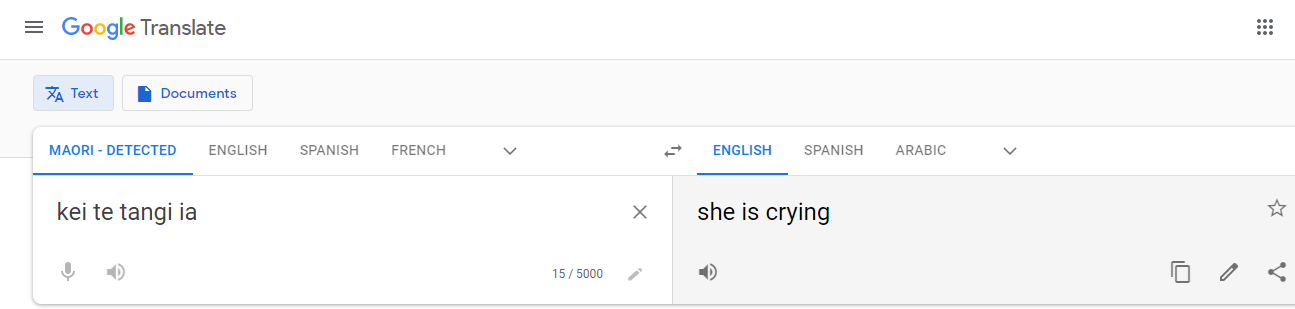
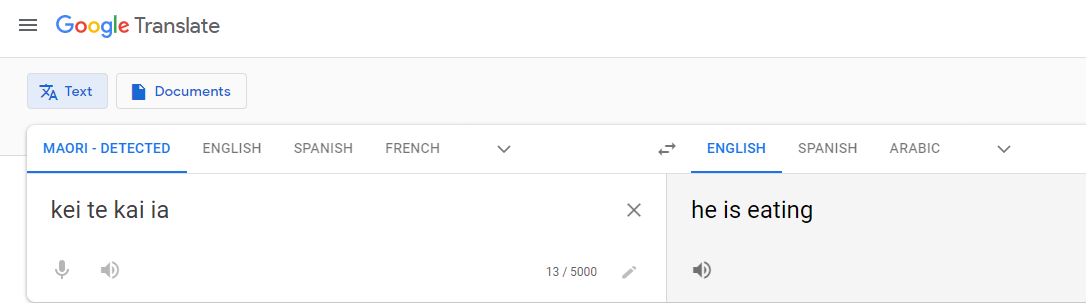
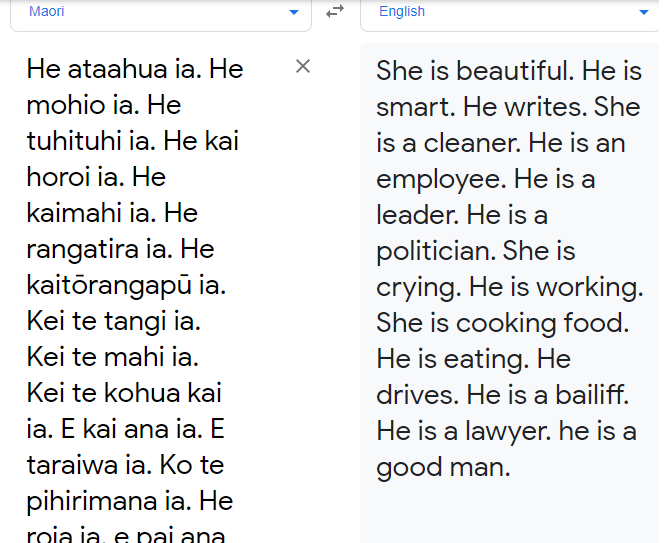
The figures below show how Google Translate decides whether “ia” is male or female depending on the scenario:
- Translated as “she”: domestic tasks such as cooking and sewing, emotions such as crying, and being promiscuous.
- Translated as “he”: most professions, trades, sports, leadership roles and humour.
- Never considered: takatāpui and LGBTQ+ people, or a gender-neutral “they”.
The results reflect a chauvinistic view that men work and hold authority, while women do domestic chores. The technology discriminates against minority genders, using te reo Māori as the vehicle. I tested a range of tenses, networks and IP addresses, with the same result each time.
Tests carried out: [TODO: month and year].
Test results: Google Translate and “ia”
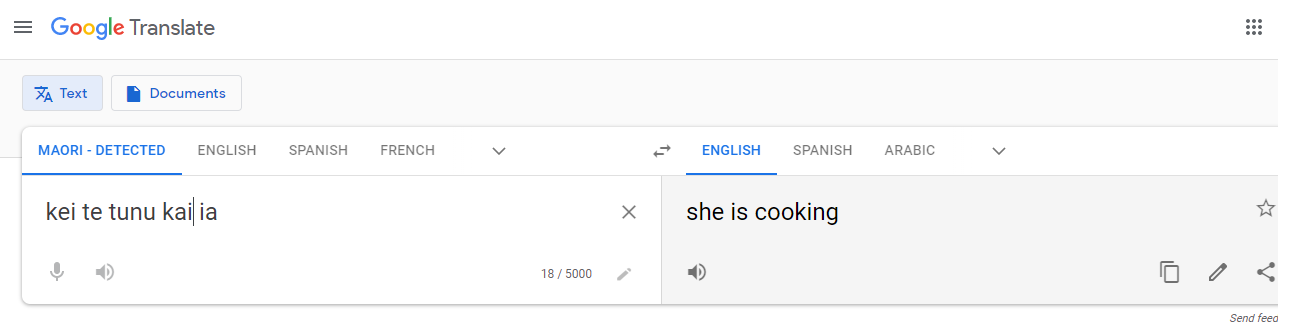
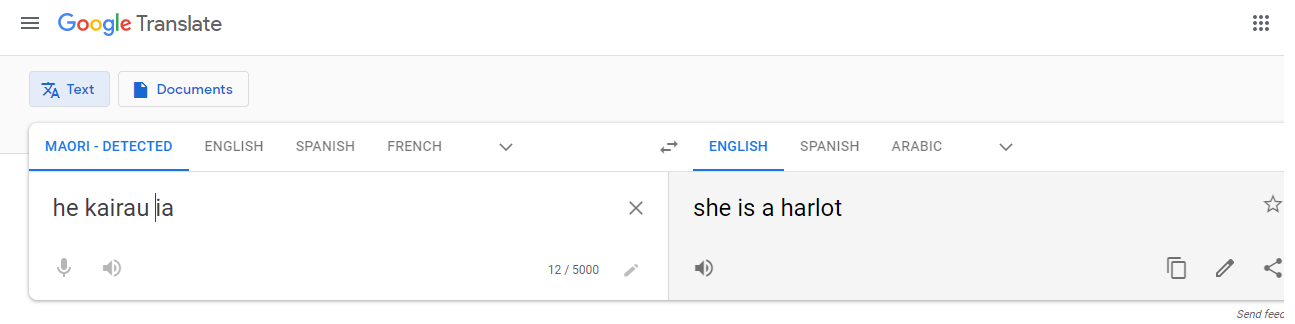
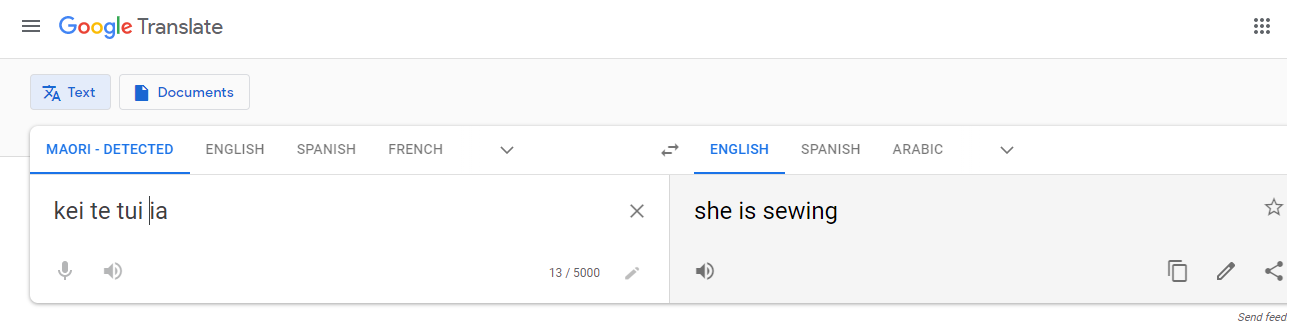
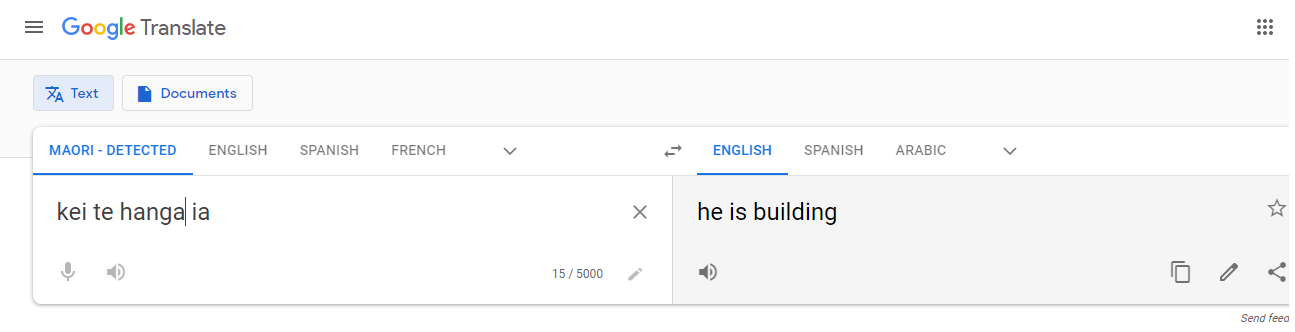

How Google Translate should handle “ia”
The proper answer is for Google to work with Māori communities on how “ia” is translated. If that is not possible, the best interim solution is to translate “ia” into English as “she/he/they”. Not doing so allows English language and culture to continue the linguistic imperialism of te reo Māori.
Raising awareness: “ia” in pronoun email signatures
Te Kawa Mataaho Public Service Commission promotes the use of pronouns in email signatures as part of its commitment to diversity and inclusion. If we all add “ia” to our pronouns, it is a simple, passive way to raise awareness of this discrimination.
Racist Google autocomplete suggestions about Māori
I first raised the problem of racist and offensive Google autocomplete suggestions about Māori in May 2010. When Stuff reported on sexism in Google search (“Shocking sexism in Google search”), the coverage focused on women. No similar attention has ever been given to the racist autocomplete suggestions about Māori or other Indigenous Peoples.
The problem is less severe today. That is mainly because Māori, iwi, knowledge workers and academics have published a large body of authentic Māori information online.
How Google autocomplete works
Google has said that autocomplete predictions reflect the search activity of all web users and the content of the pages it indexes. Predictions are generated by algorithms, based on factors including the popularity of search terms, without human intervention. Google applies only a narrow set of removal policies, covering pornography, violence, hate speech and copyright infringement.
At the time of my original testing, Microsoft Bing did not offer the same offensive autocomplete suggestions, and its image search did not return the same offensive images for searches such as “fat maori”.
Searches to test
Try these searches in Google. Some suggestions are still racist or offensive; others, such as those for Māori men and Māori women, are simply bizarre:
- Maori are
- māori are
- maori are not
- why are maori
- maori men are
- maori women are
- Maori people are
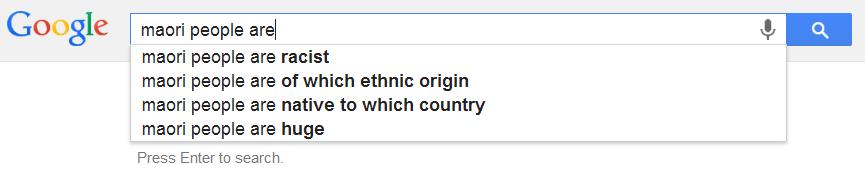




The original examples, May 2010
These 2010 screenshots show inappropriate and racist autocomplete suggestions about Māori and Polynesians. It is possible that some reflect unlucky search patterns rather than deliberate content, but the effect is the same.


The stereotype that every Māori person speaks te reo
In September 2016, a Hamilton mayoral candidate’s use of Google Translate made the news (Stuff). Social media discussion focused on the tool and its problems with te reo Māori, and missed the subtle racism in the story.
Candidate James Casson wanted to appeal to Māori voters by offering his candidate statement in te reo Māori. A staff member translated it with Google Translate, which was still in development, and the result was incomprehensible. His first mistake was assuming that a translated statement, without any understanding of Māori culture, would win Māori votes.
The more disturbing issue is what the article reported him saying: that he gave his English version to a “Maori woman” at his office to get it done. Why did he assume a Māori woman in his office could speak Māori? Would he have given it to a non-Māori staff member? Describing her that way, rather than simply as a staff member, could also be read as sexist.
This reflects a common stereotype in New Zealand: that anyone of Māori descent is automatically an expert in all things Māori, as if Māori are born knowing the language, customs and society. Nobody expects someone of Irish descent to be an expert on Irish heritage; it is a uniquely Māori expectation.
The pressure this puts on Māori at work and socially is extremely high. I have often seen organisations place all their trust and vision for Māori in a single Māori staff member who was never raised Māori and never learnt about te ao Māori. Generations of Māori were raised to believe that being Māori was shameful and that fitting in meant ignoring their heritage. Others have witnessed things in their own families and communities that lead them to identify as non-Māori, whatever their appearance.
According to Statistics New Zealand, the proportion of Māori able to hold a conversation in te reo Māori fell from 25.0 percent in 1996 to 21.3 percent in 2013. I suspect the real figure is lower, as some people may have counted themselves conversational when they knew some Māori words and a few sentences.
A short history of Google and te reo Māori, 2008–2013
These notes were written as events happened. Several of the tools and pages mentioned no longer exist.
July 2008: Google in Māori launches
In July 2008, the Google Māori interface translation project began rolling out at google.com/intl/mi, followed by a small symbolic launch with members of the community of volunteer translators. My first thoughts were that “Māori” needed its macron, and that Google should acquire google.maori.nz, which appeared to be cybersquatted.
An update on 23 July 2008 noted that much translation work was still unfinished:
- AdWords API static documentation: 0% complete
- Groups Beta: 3% complete
- Main site help pages: 10% complete
- Picasa2: 0% complete (just over 2,700 strings, many already translated in other projects)
- User Distributed Search: 100% complete
- Wireless: 17% complete
- Wireless Transcoder: 0% complete
Google’s translation tools had also become more user friendly.
Google Aotearoa and the “Your Local Domain” page
The project was later renamed from Google Māori to Google Aotearoa, which better reflects our bilingual country. Its community wiki, however, was in English. Google’s “Your Local Domain” page listed every country’s Google homepage with its flag, but Aotearoa was not included.
That raised a question: which flag would represent Aotearoa? The Tino Rangatiratanga flag has been strongly promoted as the Māori flag, including being flown on the Auckland Harbour Bridge on Waitangi Day. But it is not a national Māori flag, and many iwi have their own, including Tūhoe, Ngāti Tūwharetoa and Ngāi Tahu. In a time of globalisation and localisation, perhaps Aotearoa New Zealand should consider a new flag that represents the whole country. Te reo Māori, after all, has its own language code, “mi”, and is becoming an international language on the internet.
October 2009: Google Translator Toolkit adds te reo Māori
On 15 October 2009, Google announced Māori support in Google Translator Toolkit, made possible by Dr Te Taka Keegan of the University of Waikato while on secondment to Google. Unlike Google Translate, Translator Toolkit was edited by people rather than automated. It stored community translations in a translation memory and reused them when familiar sentences came up again. It handled documents, HTML, websites and PDF files, and shared translations could be corrected, given macrons or fixed for grammar.
At launch it had very little Māori content; I could not get automated translations for several basic documents, including Google’s own media release about supporting Māori. I encouraged anyone with word lists or electronic dictionaries to upload them to grow the Māori corpus. Google closed Translator Toolkit in 2019.
December 2013: Google Translate adds te reo Māori
In December 2013, Google added te reo Māori to Google Translate, translating to and from English, as one of several minority languages. For years automated Māori translation had been a dream that most people never expected to come true. Early translations were mediocre and often missing macrons, and Google asked fluent speakers to rate translations to improve the system. Even so, it worked well for an early system.
Related reading
- Digital colonialism: including commercial ownership of translated terminology and search results that hide or alter Traditional Knowledge
- Māori Data Sovereignty Principles
- He Tangata, He Karetao, He Ātārangi: a kaupapa Māori AI framework
Frequently asked questions
Is the Māori pronoun “ia” gender neutral?
Yes. “Ia” refers to a person of any gender, including takatāpui and LGBTQ+ people. It can mean he, she or they.
Does Google Translate show gender bias in te reo Māori?
Yes. Dr Karaitiana Taiuru’s testing found that Google Translate converts “ia” into “she” for domestic tasks and emotions and “he” for most professions, trades, sports and leadership roles, and never into a gender-neutral form.
How should “ia” be translated into English?
Ideally, as decided with Māori communities. As an interim solution, Dr Taiuru recommends translating “ia” as “she/he/they” so that no gender is assumed.
When did Google Translate add te reo Māori?
Google added te reo Māori to Google Translate in December 2013. Google’s search interface had been available in te reo Māori since 2008, and Google Translator Toolkit supported Māori from 2009 until it closed in 2019.
How to cite this page
Taiuru, K. (2013, October 20). Google. Taiuru & Associates Ltd. https://www.taiuru.co.nz/google/