Introduction
For more than eight years I have been extracting, analysing and commenting on the Māori data buried within New Zealand’s online safety research. This page brings that work together in one place.
The pattern across these reports is consistent and troubling. Māori, particularly rangatahi, wāhine and those with a disability, are over-represented as victims of online harm: unsolicited nude images, harassment, racist abuse, hate speech and exposure to extreme or illegal content. At the same time, Māori are more likely to be convicted once charged under the Harmful Digital Communications Act, even though Māori are not the group most likely to be charged.
Just as consistent is the absence of Māori from the design of the research itself. Surveys are rarely built on kaupapa Māori or Indigenous research methodologies. Māori participation is often too low to report on without statistical weighting. Whānau is read through a Pākehā definition of family. The generations raised in Kōhanga Reo and Kura Kaupapa, who think and speak in te reo Māori first, are largely invisible. The result is that Māori are counted as a problem but rarely consulted about solutions.
The analyses that follow draw on reports from NetSafe, the Classification Office, the Ministry of Justice and ActionStation, published between 2018 and 2026. Each section summarises the Māori-specific findings, followed by my commentary and, where relevant, recommendations.
Taken together, they make a clear case. Online safety in Aotearoa cannot be achieved through generic resources and agencies that treat Māori as an afterthought. It requires culturally safe reporting pathways, kaupapa Māori resources grounded in tikanga and mātauranga Māori, Māori expertise at governance level, and an online safety system that honours Te Tiriti o Waitangi.
Key findings at a glance
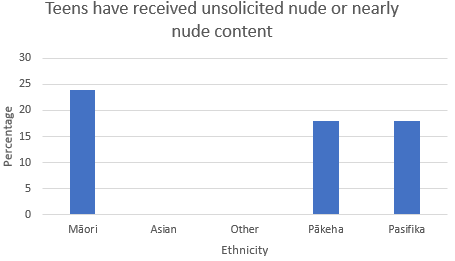
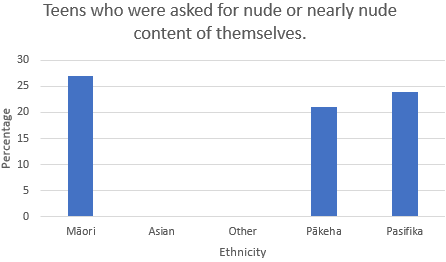
- Sexting: 24% of Māori teens had received unsolicited nude or nearly nude content and 27% had been asked for nudes of themselves, the highest of any ethnic group (NetSafe, 2017).
- Harassment: Māori teens were significantly more likely to have lies or rumours spread about them (33%) and to be called names (33%); 16% had been threatened online (NetSafe, 2018).
- Racist abuse: One in three Māori (33%) experienced racial abuse and harassment online in 2018 (ActionStation, 2019).
- Hate speech: 90% of Māori who experienced online hate believed it was motivated by ethnicity (NetSafe, 2018).
- Extreme content: 79% of Māori had seen at least one type of extreme or illegal content, and 18% saw such content at least a few times a month (Classification Office, 2026).
- Justice: Once charged under the Harmful Digital Communications Act, 77% of Māori were convicted, compared with 63% of Europeans, 48% of Asian and 31% of Pacific people (Ministry of Justice, 2021).
- Research design: Māori are routinely under-sampled, require post-survey weighting, and are surveyed without kaupapa Māori methodologies.
Sexting, pornography and image-based abuse
Prevalence and attitudes of Māori teenagers about sexting
In late 2017 NetSafe released a research report about New Zealand teenage sexting. NetSafe stated that it was the first time this type of research had been completed in New Zealand, and described it as a snapshot they hoped would be a springboard for more research. This analysis extracts the Māori-related data to better understand the current risks to Māori youth.
Download the complete Māori statistics report (PDF)
Summary of findings
- Māori teenagers are more likely than any other ethnicity to receive unsolicited nude or nearly nude content, and to be asked for nude content of themselves.
- Māori teenage girls are more likely than girls of any other ethnicity to be targeted with requests for nude content, or to be sent nude content without asking for it (based on all-female statistics).
- Analysis of the disability data indicates that Māori girls with a disability are likely to be more vulnerable to receiving, and being asked for, nude content than girls with no disability (based on overall findings).
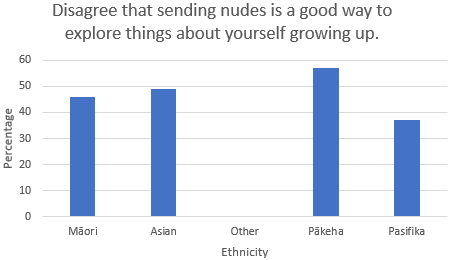
- Māori and Pacific teens do not think sharing nude pictures of themselves is a good way to explore themselves as they grow up, compared with 20% more NZ European/Pākehā teens who believe it is.
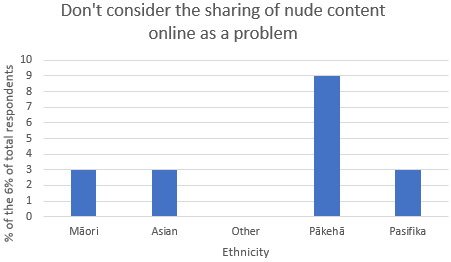
- Most teens consider sending nude content a problem. Of the minority who consider it acceptable, NZ European/Pākehā were three times more likely than Māori, Pacific and Asian teens to hold that view.
- Sharing nude content is not commonly spoken about in Māori teen culture.
Of about 240 Māori participants aged 14–17:
- approximately 58 had received unsolicited nude or nearly nude content
- approximately 65 had been asked for nude or nearly nude content of themselves
- 110 disagreed that “sending nudes is a good way to explore things about themselves as they grow up”
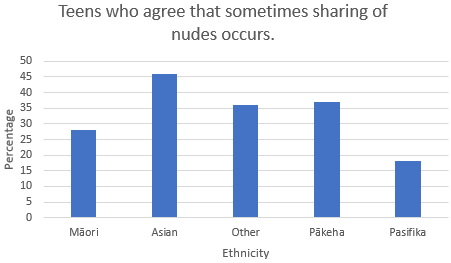
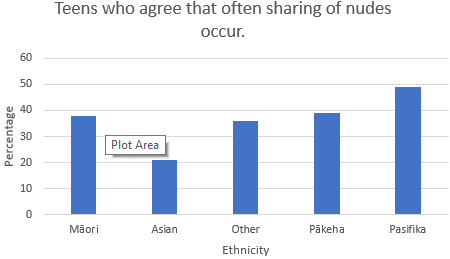
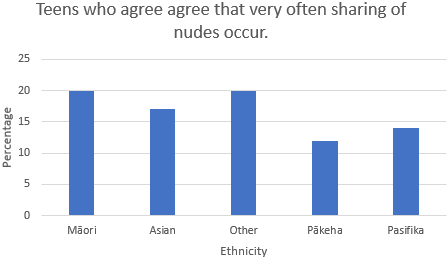
- 36 agreed that sharing of nudes rarely occurs; 67 that it sometimes occurs; 91 that it often occurs; and 48 that it very often occurs
- approximately 2 did not consider the sharing of nude content online to be a problem.
Definition of sexting
The broadly accepted definition of sexting is sending, receiving or forwarding sexually explicit messages, photographs or images, primarily between mobile phones. It may also include the use of a computer or any digital device (Salter, 2013).
Introduction
The results identify the need for Māori-specific research using kaupapa Māori research methodologies (Smith, 1999). Such an approach would better enable researchers to design, survey, collect and analyse data specific to Māori youth. This report also identifies trends that show directly how Māori are affected by sexting.
The results did not differentiate Māori by gender, knowledge of te ao Māori or disability. Mixed ethnicities were not reported, which made some statistics difficult to identify clearly. Where a conclusion is obvious by extrapolation, this is noted.
Methodology
This report analyses and extracts data from the NetSafe survey (retrieved December 2017), whose objective was to understand the prevalence and extent of nude-sharing among teens aged 14–17. The survey:
- had 1,001 participants, of whom about 240 (24%) self-identified as Māori
- also included about 660 NZ European/Pākehā (66%), 130 Pacific (13%), Asian (13%) and 40 (4%) “other ethnicity” participants (participants could select more than one ethnicity)
- was conducted with an online survey tool over five weeks
- asked about activity over the previous 12 months
- had a margin of error of 3.1%.
This report is independent of any third party, including the author and publisher of the original survey.
Comparison of Māori teenagers with other ethnicities
| Measure | Māori | NZ European/Pākehā | Pacific | Asian | Other |
|---|---|---|---|---|---|
| Received unsolicited nude or nearly nude content | 24% | 18% | 18% | – | – |
| Asked for nude or nearly nude content of themselves | 27% | 21% | 24% | – | – |
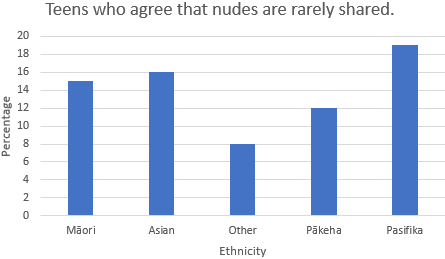
| Agree nudes are rarely shared | 15% | 12% | 19% | 16% | 8% |
| Agree nudes are sometimes shared | 28% | 37% | 18% | 46% | 36% |
| Agree nudes are very often shared | 20% | 12% | 14% | 17% | 20% |
| Disagree that sending nudes is a good way to explore yourself growing up | 46% | 57% | 37% | 49% | – |
| Do not consider sharing nude content online a problem | 3% | 9% | 3% | 3% | – |
View the original charts (E1–E8)
Māori voices in the research
Participants mentioned social pressure as a significant factor in the sharing of nude content among some teens:
“Mostly, I think it’s all to do with peer pressure. If your friends are doing it then they think you should too. I think that’s stupid.”
Some comments placed nude-sharing in the context of developing and maintaining romantic relationships, and as a way to build trust with partners:
“It’s usually because they like the boy/girl who asked for the nude pics and they’ll do whatever he/she says just to make him/her like them or ask them out. That’s what happens with girls at my school, don’t know if it’s the same elsewhere.”
Survey questions with no Māori feedback
- Moral stance about the behaviour (p. 28): 17% of participants held a moral stance against teens who send nudes of themselves. There were four NZ European comments and one Asian comment.
- Sexual exploration/relationships (p. 29): 15% of comments fitted this category. These views were more common among Asian (22%) and NZ European/Pākehā (17%) teens.
Considerations for future kaupapa Māori research on teens and sexting
- There are generations of Māori who are native speakers of te reo Māori, educated at Kōhanga Reo and Kura Kaupapa Māori. Their belief systems and their exposure outside Māori environments differ from those of children not raised in the same environment.
- Offer the survey in te reo Māori.
- Māori who are comfortable with, and strongly affiliated to, their marae, whānau and iwi are likely to hold different values (Statistics New Zealand, 2014).
- Results were not broken down by gender within ethnicity. That breakdown would show whether Māori teenage boys or girls are more at risk, and where.
- New Zealand has a long, well-documented history of mixed-ethnicity relationships dating from the first arrival of Europeans (Te Ara, Intermarriage).
- For some Māori, identifying only as Māori is not acceptable; they prefer to identify as Māori/European, Māori/Samoan and so on. Participants who did not identify with a single group were categorised as “other ethnicity”.
- The 150 teens with a disability were not classified by ethnicity, so there is no direct evidence about Māori teens with a disability. This report has extrapolated from the overall Māori percentages.
- Communal computers at marae and other whānau and iwi locations were not discussed.
- Some Māori choose not to answer ethnicity questions because of the long-established practice of using only negative statistics about Māori.
- Mistrust of social and government agencies was not considered (Winiata & Fraenkel, 1967).
- Despite an on-screen warning recommending respondents complete the survey alone, about 300 participants completed it with a parent or caregiver nearby. This could skew results for any participant.
- An on-screen warning may not deter other whānau from sitting in front of the screen.
- Research on Māori behaviour with technology commissioned by Te Puni Kōkiri (2007, 2010), Research NZ (2009a, 2009b), Sciascia (2017) and Clark (2001) should be considered.
Conclusion
Māori teenagers receive unsolicited naked pictures, and are asked for naked pictures, at a higher rate than any other ethnicity, even though many Māori teenagers believe sexting is not a good idea. The overall statistics suggest that Māori female teenagers with a disability are at higher risk of unwanted sexting and sexting requests than other groups.
More safety resources and education are needed for Māori teenagers, including kaupapa Māori safety resources for Māori children of all ages and for those raised in kaupapa Māori environments such as Kōhanga Reo, Kura Kaupapa Māori and marae communities. Targeted research on Māori teenagers and sexting using Indigenous research methodologies would provide more accurate data on the risks and how to counter them.
References
- Clark, V. N. (2001). Cultural influences in contribution to electronic group communication discussions. He Pukenga Kōrero, 6(2).
- Netsafe. (2017). Teens and “sexting” in New Zealand: Prevalence and attitudes. Netsafe.
- Research New Zealand. (2009a). Current and future broadcasting and e-media preferences of Māori youth: Qualitative research report.
- Research New Zealand. (2009b). New Zealanders’ use of broadcasting and related media: Final report.
- Salter, M. (2013). Beyond criminalisation and responsibilisation: Sexting, gender and young people. Current Issues in Criminal Justice, 24, 301–316.
- Sciascia, A. D. (2017). Māori cultural revitalisation in social networking sites. Te Puni Kōkiri.
- Smith, L. T. (1999). Decolonizing methodologies: Research and indigenous peoples. Zed Books; University of Otago Press.
- Statistics New Zealand. (2014). Taku marae e: Connecting to ancestral marae 2013.
- Te Puni Kōkiri. (2007). Te ao pāpaho Māori: Māori broadcasting and e-media. Te Puni Kōkiri.
- Te Puni Kōkiri. (2010). Use of broadcasting and e-media, Māori language and culture. Te Puni Kōkiri.
- Winiata, M., & Fraenkel, M. (1967). The changing role of the leader in Maori society: A study in social change and race relations. Blackwood and Janet Paul.
Young Māori favour an online pornography filter
An analysis of the Māori data in the Classification Office’s December 2018 report. A young person is defined as aged 14 to 17. The report defined pornography as “explicit images, video, or movies of a person or people having real sex or doing sexual things and you can see their genitals”.
Key findings
- Exposure to pornography and frequency of use are broadly similar among Māori, Pacific and NZ European youth.
- 73% of young Māori had seen pornography, compared with 72% of Pacific and 69% of NZ European youth.
- Accidental first exposure is more common among Māori and Pacific youth. This may reflect lower confidence and knowledge about keeping safe online; NetSafe’s 2018 research found Pacific and Māori youth reported lower awareness of online safety than NZ European youth.
- Young Māori were less likely to have seen romance or affection in pornography (63%, vs 80% of non-Māori), but just as likely to see it often. There were no other significant differences by ethnicity.
- NZ European and Māori youth were more likely to have talked with a parent or caregiver about pornography.
- Support for some form of online restriction, such as filters or age verification, was highest among Māori and Pacific youth.
Recommendations
- There is a dire need for specific Māori online safety resources, as Māori are more likely to be victims and to seek help from whānau.
- As young Māori favour an online filter, this should be given serious consideration.
Harassment, racism and hate speech
Māori teens are more likely to be victims of online predators
Māori teens, especially girls and those with a disability, are at higher risk than any other ethnic group in New Zealand of being harassed and receiving unsolicited nude images.
The latest NetSafe report shows Māori are more likely to be harassed online through unwanted communications. The most common types were being contacted by a stranger and accidentally seeing inappropriate content. NetSafe’s sexting report also found Māori are more likely to receive unwanted nude images or requests for them.
This is a growing concern given the lack of targeted resources to protect Māori teenagers from online predators. More concerning still, Māori females and those with disabilities are even more vulnerable. I was interviewed by He Kawe Kōrero on Māori Television on this issue, and the presenters offered some valuable thoughts to help whānau.
Key Māori findings
- Māori girls aged 14 and 15 are the most vulnerable, even more so if they have a disability.
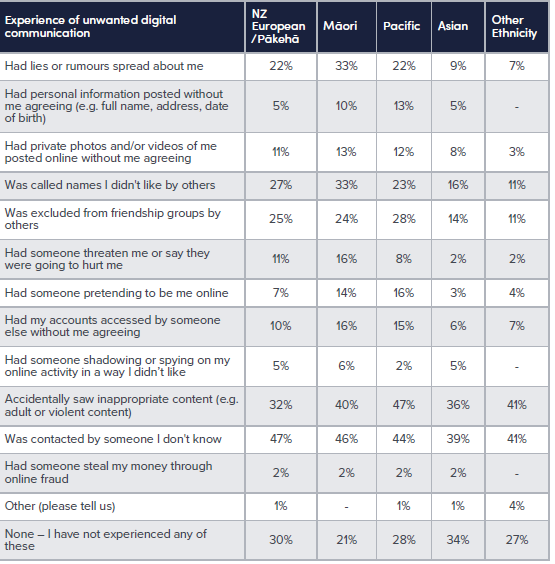
- Māori teens were significantly more likely to have lies or rumours spread about them (33%) and to be called names they did not like (33%) than other ethnic groups.
- 16% of Māori teens reported being threatened online, compared with 11% of NZ European/Pākehā teens and 8% of Pacific teens.
- Māori and Pacific teens were more likely to receive unwanted digital communications across a range of types.
Channels for unwanted digital communications
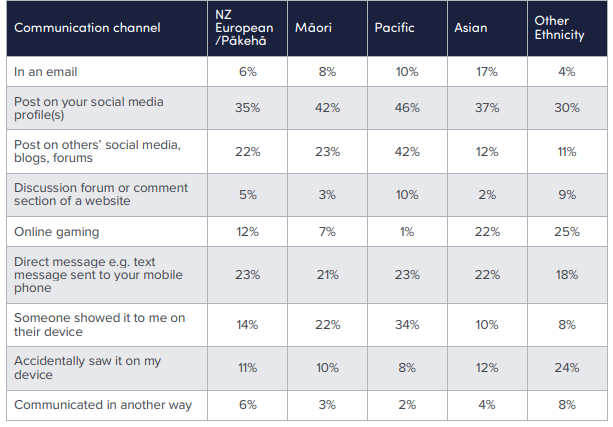
Māori are more likely to be harassed on social media and by text message. This is likely because, as Te Puni Kōkiri research in 2015 showed, Māori are high users of social media and mobile phones.
Senders of unwanted digital communications
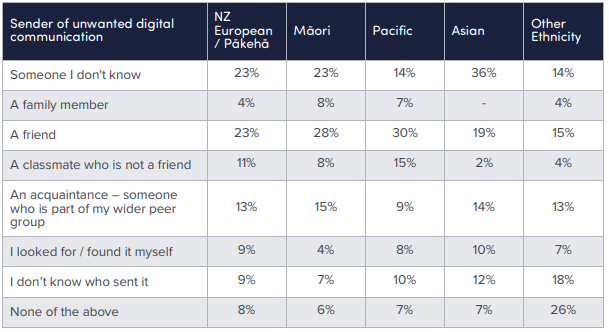
Māori are more likely to be harassed by a friend or a stranger. There may be two explanations. One is that it reflects unconscious bias and racism in New Zealand society. The other comes from my own experience as an online Māori commentator: any comment I make online about Māori rights and beliefs attracts a torrent of abuse. This highlights the need for the same research to be done with adults.
Experience of digital harm
Māori are more likely than other ethnic groups to have had lies and rumours spread about them and to have been called names.
Confidence with digital technology and online safety
- Pacific and NZ European/Pākehā teens were more confident about their digital competencies (46%) than Māori (39%) and Asian teens (36%).
- Overall, 29% said they knew “a lot” about online safety, 58% “a fair amount” and 13% “not that much”. Pacific (26%) and Māori (17%) teens were more likely to say they knew “not that much”.
- Māori (55%) and Pacific teens (48%) were more likely than other groups to seek support from a parent or caregiver.
Māori experiences of online hate speech
This article extracts the Māori-specific information from NetSafe’s report, offers my analysis and describes my personal experience of online hate. My critique of the report’s definitions is at the end.
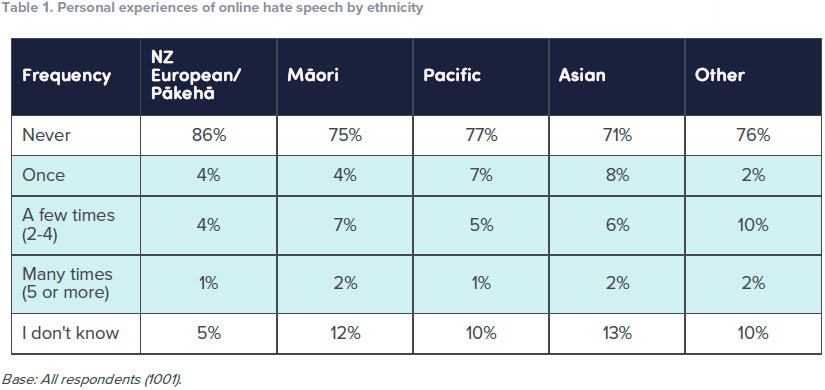
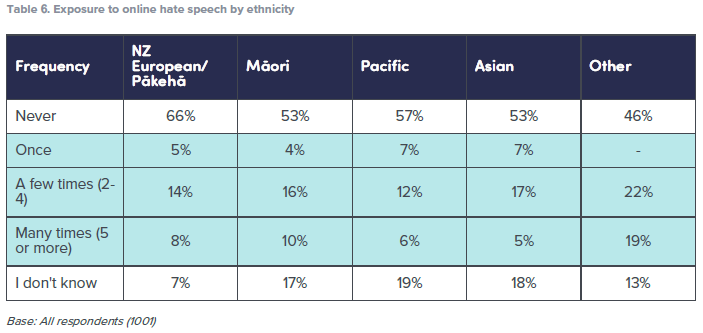
Māori appear statistically better off than some other minority ethnic groups in being targeted by online hate. But when Māori were exposed to online hate, it was more persistent. Pākehā are the least likely to be exposed to online hate and the least likely to believe it is about race or ethnicity.
My personal experience
My personal experience of online hate is large and varied, but I can summarise it in two categories: from non-Māori and from Māori.
The online hate I receive from non-Māori ranges from a few hateful comments to paragraphs of diatribe. The worst occurs when a media article has comments turned on. I no longer read the comments, as they are a hate-fest of knee-jerk statements.
From Māori it is the usual questioning: who am I to say that, I do not speak on their behalf, derogatory comments about my southern iwi links and how colonised and corporate we are, and nit-picking my choice of words. I do try to use phrases such as “in my opinion” and to speak only on topics I am knowledgeable about. Younger Māori often send me Facebook messages to express their concerns, and some comment on my blog using false email addresses (the IP address is still visible).
Reo bullying sometimes plays a part, with comments such as “why don’t you say it in reo?”. The most prolonged public hate I have endured came from a Māori television presenter (I will not name the person or the station). It occurred on Facebook and was very public. The person had clearly followed my media appearances and blogs, and claimed I was not an expert, that my interpretation was wrong and merely personal, asked who I was and what whakapapa rights I had to speak, and called me a fraud, a dreamer and egotistic, among other things.
Eventually a mutual friend, a tuakana to us both, told the person they were wrong about the key facts they had used to abuse and belittle me, and that if they knew their history and whakapapa they would see I was correct. The abuse stopped. I then blocked the person on all social media.
Key findings
- Among minority ethnic groups, Māori were the second least likely to experience online hate (Pacific people the least). Asian people and those in the “other” category were most likely to be victims.
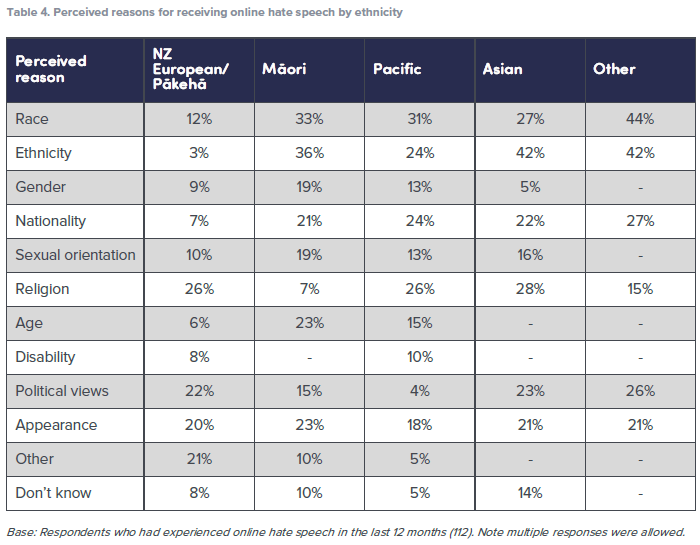
- Māori, Pacific and Asian respondents saw ethnicity as the main reason for hate speech; NZ Europeans/Pākehā saw religion.
- Māori believed the online hate they were exposed to was motivated mainly by ethnicity, but also by political views.
- Māori are less likely to have ever experienced or been exposed to online hate than Pākehā, Pacific people and other ethnicities. But of those who have experienced it, Māori experience it at a higher rate than all other ethnicities.
- 90% of Māori and 91% of Asian respondents believe online hate is racially motivated, compared with 19% of Pākehā. Māori are also more likely to see online hate as motivated by sexual orientation.
- Māori are the least likely to see religion and disability as reasons for online hate.
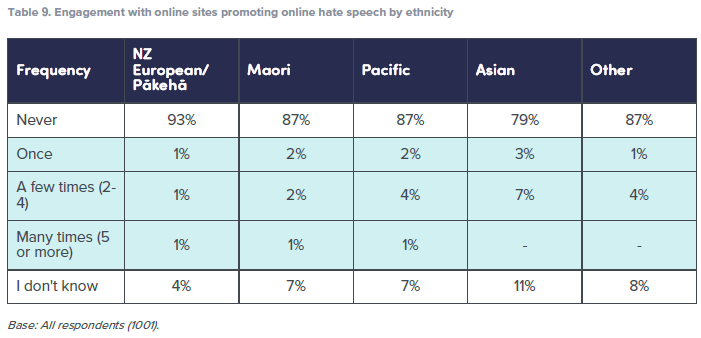
- Māori are the least likely to engage with websites promoting online hate speech.
It would be valuable to survey Māori who write and produce Māori content online, engage in social media dialogue, and comment on media articles about Māori, to see whether their experience differs. A question asking how many people they have blocked on social media because of hate speech would also be telling.
| Frequency | Māori | Pākehā | Pacific | Asian | Other |
|---|---|---|---|---|---|
| Never | 75% | 86% | 77% | 71% | 76% |
| Once | 4% | 4% | 7% | 8% | 2% |
| 2–4 times | 7% | 4% | 5% | 6% | 10% |
| 5 or more times | 2% | 1% | 1% | 2% | 2% |
| Don’t know | 12% | 5% | 10% | 13% | 10% |
It would be interesting to know why some respondents answered “don’t know”. As this was an online survey, it is possible family members were nearby and respondents felt the need to answer that way.
| Perceived reason | Māori | Pākehā | Pacific | Asian | Other |
|---|---|---|---|---|---|
| Race/ethnicity | 90% | 22% | 79% | 91% | – |
| Religion | 26% | 26% | 26% | 28% | 15% |
| Age | 23% | 6% | 15% | – | – |
| Appearance | 23% | 20% | 18% | 21% | – |
| Gender | 19% | 9% | 13% | 5% | – |
| Sexual orientation | 19% | 10% | 13% | 16% | – |
| Political views | 15% | 22% | 4% | 23% | – |
| Other | 10% | 21% | 5% | – | – |
I have combined race and ethnicity in the table above. Appearance could also fall within race/ethnicity, but this is not clear. It is notable that Pākehā do not see race and ethnicity as a reason for online hate.
| Frequency | Māori | Pākehā | Pacific | Asian | Other |
|---|---|---|---|---|---|
| Never | 53% | 66% | 57% | 53% | 46% |
| Once | 4% | 5% | 7% | 7% | – |
| 2–4 times | 16% | 14% | 12% | 17% | 22% |
| 5 or more times | 10% | 8% | 6% | 5% | 19% |
| Don’t know | 17% | 7% | 19% | 18% | 13% |
| Frequency | Māori | Pākehā | Pacific | Asian | Other |
|---|---|---|---|---|---|
| Never | 87% | 93% | 87% | 79% | 87% |
| Once | 1% | 1% | 2% | 3% | 1% |
| 2–4 times | 2% | 1% | 4% | 7% | 4% |
| 5 or more times | 1% | 1% | 1% | – | – |
| Don’t know | 7% | 4% | 7% | 11% | 8% |
View the original charts
Critique of the report’s definitions
Hate speech. NetSafe defined hate speech as “any technology-mediated speech or digital communication that offends, discriminates, denigrates, abuses and/or disparages a person(s) on the basis of a group-defining characteristic such as race, ethnicity, gender, nationality, sexual orientation, religion, age, disability, and others.”
NZ European/Pākehā. It is not clear why this is the only bilingual ethnic label in the report. In this analysis I use “Pākehā”, as the bilingual label creates confusion.
Race, ethnicity and nationality. The report treats these as three separate categories without explaining the difference. The Oxford dictionary defines race as each of the major divisions of humankind with distinct physical characteristics, or a group sharing the same culture, history and language; ethnicity as belonging to a social group with a common national or cultural tradition; and nationality as an ethnic group forming part of one or more political nations. By splitting these categories, the report makes racism as a motivation for hate speech less obvious and hides the real issue.
Background to the report
The 1,001 respondents aged 18 and over were 52% female, 47.7% male and 0.03% gender diverse. By ethnicity: Pākehā 71%, Māori 11%, Pacific 5%, Asian 11% and other 9%. Māori and Pacific sub-populations were deliberately boosted beyond what a random sample would achieve. The report does not state whether the Māori percentages are based on Māori respondents only or on all respondents.
Māori are still prominent victims of online bullying
ActionStation’s research discusses the impact and usefulness of the Harmful Digital Communications Act (HDCA), a powerful piece of legislation enacted to address online abuse, which is nonetheless not sufficient to address every form of online hate, harassment and abuse. The survey asked about social media use, experiences of online harassment and its impact. Of those who had experienced harassment, most had faced racist comments, messages or images.
This section summarises the report’s Māori-specific content, with my commentary marked separately.
The role of NetSafe
The report finds NetSafe effective, but its work relies on platforms’ community standards and enforcement to remove content when abusers will not. NetSafe is not an enforcement agency; that role sits with the courts. Little support is available to people making HDCA complaints if mediation fails, because NetSafe must remain an impartial mediator and cannot act as victim support if it recommends a case proceed to court. There is a concerning drop-off between cases NetSafe recommends for court and those that actually proceed, pointing to a lack of victim support and contributing to a shortage of case law.
My experience of NetSafe is that it is a great organisation with many constraints, one being that it is not equipped for Māori victims of online harm. Considering research proves Māori are over-represented as victims, more needs to be done to represent Māori.
Online bullying and abuse of Māori can, in addition to conventional abuse, be cultural and racist, sometimes in subtle ways that non-Māori do not understand. Then there are the generations of Māori children raised in Kōhanga Reo and Kura Kaupapa Māori who speak te reo Māori as a first language. Their values are different and need to be considered.
At the 2018 NetSafe conference we heard from Lani Wendt Young, who shared horrific stories of online abuse. Part of her difficulty was that the abuse was in Samoan, not English, and neither NetSafe nor other agencies, including Facebook, had the resources to deal with it. Cultural norms and values must be considered when dealing with online harassment and abuse of minority groups.
Māori rights and collective wellbeing
One of the most significant themes in the research was the need to attend not only to individual concerns such as rights and privacy, but also to collective dynamics and wellbeing. Policies to protect people online therefore need Indigenous and collectivist thinking at their centre, especially as Māori have historically been, and remain, among the most targeted by hateful speech.
Constitutional lawyer and justice researcher Moana Jackson pointed out:
“The right to free speech [in New Zealand]… has too often meant the freedom to hurt, despise, and belittle Māori. Cartoons published a few years ago depicting fat and lazy Māori taking advantage of free school lunches were found by the court to be objectively offensive but protected by free speech and the fact that they weren’t offensive enough to incite a ‘reasonable person’ to hatred or violence against our people.”
Graham Cameron, then a doctoral student in Theology and Religion at the University of Otago, has written about whakawhanaungatanga instead of censorship. Whakawhanaungatanga means building familial connections with others, the relationships that bind us together. On this view, limiting people’s ability to be racist and sexist is less about censorship and more about upholding whanaungatanga.
The difference between Māori and Western worldviews on the power of speech is captured by two proverbs. In English: “Sticks and stones may break my bones, but words will never hurt me.” In te reo Māori: “He tao rākau, e taea te karo; he tao kōrero, e kore e taea te karo”, “The taiaha can be parried aside but words go straight to the heart.” In the Māori world, a culture steeped in oral tradition, words create worlds and words matter.
Samoan author Lani Wendt Young, who has received horrific online abuse, says:
“The public shaming associated with online abuse is amplified many times over when you are Samoan… Because an attack on the individual is an attack on the extended family.”
Our human rights, hate speech and communications laws need to acknowledge collectivist cultures and prioritise collective, wellbeing-based solutions. In the report, I am cited as saying that two Māori values could help those who build technology create a safer, better internet:
- Manaakitanga: how can we build tools that encourage users to show each other care and compassion and work to uplift each other?
- Kaitiakitanga: how can we build tools where all users become guardians of the experience and data in a highly trusted, inclusive and protected way?
These values apply equally to Te Tiriti rights and Māori data sovereignty.
Māori statistics and experiences
The survey asked 618 Māori, Pacific and Asian people about their experiences in 2018.
| Measure | Māori | Pacific | Asian |
|---|---|---|---|
| Experienced racial abuse and harassment online | 33% | 21% | 25% |
| Lower self-esteem or loss of confidence as a result | 26% | 34% | 33% |
| Felt powerless to respond to the abuse | 19% | 18% | 34% |
- One respondent said: “Some people have singled me out for abuse during some topics because I am Māori.”
- Most people who faced harassment changed their behaviour because of it; 14% of Māori stopped posting content that expressed their views.
- Abuse happened most often on Facebook, the most popular social network among those surveyed and in the country.
Unitec research into perceptions of community safety in West Auckland found that heavy social media use, particularly of Facebook and Neighbourly, increased Pākehā fear of crime, even though Pākehā were the group least affected and crime rates were falling. Pākehā social media use was significantly higher than other ethnic groups (89% vs 69%), as was their anxiety about others in their community. Pākehā wanted more police and tougher justice policy, while other ethnic groups wanted initiatives that support community engagement and connection.
YouTube spreads misinformation about New Zealand history
The report found that much New Zealand-based misinformation on YouTube spreads falsehoods about New Zealand history to hundreds of thousands of people. A search for “New Zealand History” in a private browser returned, as the top result, New Zealand Skeletons in the Cupboard, a discredited racist “documentary” pulled from TVNZ for inaccuracy, with over half a million views. Its recommendations led to videos about a supposed pre-Māori civilisation, lectures by figures known for anti-women views, and, within a handful of clicks, American far-right figures arguing for white supremacy.
Stuff comment sections and racist abuse of Māori
As a regular media commentator, I know first-hand that Stuff’s comment sections were the worst place online, worse than WhaleOil, for racist, uninformed diatribe fuelled by hate and a lack of facts.
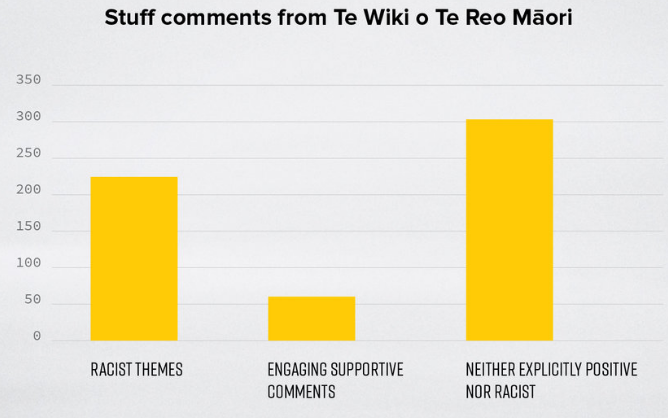
From August to October 2018, ActionStation ran a pilot called Tauiwi Tautoko, training 20 volunteers to spend an hour a week in online forums listening, engaging and seeking common ground, with the aim of encouraging more caring, thoughtful and informed responses to Māori people, culture and language. Their records were analysed by an independent researcher from a University of Otago project, coding comments against 15 racist themes.
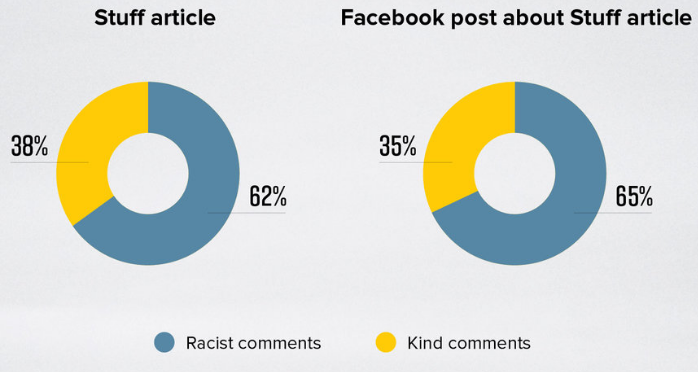
- Stuff: six articles with 446 comments produced 225 references to racist themes and only 66 positive, engaging comments. Only 15% of comments were supportive, even with volunteers active in the forum. On average, readers encountered nearly four racist ways of thinking for every kind comment.
- Facebook: eleven posts with 4,011 comments produced 553 references to racist themes (14%) against 124 supportive comments (3%). The remaining 83% were neither explicitly kind nor racist, but many were unpleasant or unkind. Users encountered nearly five racist ways of thinking for every kind comment.
- A basic count of one Stuff article and the matching Facebook post found people were twice as likely to encounter racist comments as kind ones.
- The same names and pseudonyms appeared repeatedly across the 19 articles and posts and 4,867 comments, confirming organised trolling.
ActionStation was concerned not only that these views are held, but that forums exist that allow and invite them, despite censorship guidelines that condemn material which “degrades or dehumanises or demeans any person”. Exposure to racism has serious effects on health and wellbeing, so online racial discrimination must be addressed as part of online safety. Both Stuff and Facebook had comment policies, but these were not shown alongside the comments. New Zealand research suggests successful trolling requires motivated trolls, reactive targets and the absence of capable guardians, which raises the question: are Facebook and Stuff capable guardians? The research suggests not.
Conclusion
More must be done to protect Māori online from trolls, abuse and bullying. Agencies such as NetSafe, InternetNZ and the Ministry of Justice need to recognise that this is an issue affecting Māori, and work with Māori and iwi to create preventive solutions and resources.
Organisations such as Stuff need to moderate comments for hate speech and lift their community standards generally, as this also affects their readership. Conglomerates such as Facebook need to consider minority groups and how best to deal with language and cultural issues online.
Māori statistics of online hate speech after 15 March
NetSafe’s 2019 report explores adult New Zealanders’ experiences of, and exposure to, online hate speech. It was commissioned as a direct result of the 15 March 2019 terrorist attacks on the Al Noor Mosque and Linwood Islamic Centre in Christchurch, which killed 51 people and injured 49. It compares results with the 2018 report summarised above.
- Footnote 8 on page 4 identifies “Christian Māori” as one of New Zealand’s largest religious groups. It is unclear what is intended, as there is no such religious group. Māori are Christians and followers of other religions. Describing “Māori Christians” as a major religious group is offensive and contradictory, as Māori religion is distinct from Christianity.
- Since the attacks, hate speech against Māori increased by 1%, against Pacific people by 3% and against other ethnicities by 8%. It decreased by 5% for Asian people.
- Exposure to online hate increased among Māori (10%) and Pacific people (5%).
- Pacific, Asian and Māori respondents rated race and ethnicity hate speech as more serious than religious hate speech.
- Pacific (79%) and Māori (75%) respondents showed the highest agreement that “hateful online content is growing in New Zealand and around the world”.
Despite those horrific events, and media claims that New Zealand is not a racist country, online hate speech against Māori and other minorities increased.
Children, parents and internet access
Internet safety statistics 2019
Image-based sexual abuse (2019)
Māori findings: Threatening someone with image-based sexual abuse (IBSA) was more common among Asian (8%) and Māori (6%) respondents than other groups.
Overall findings:
- Nearly 5% of adult New Zealanders have personally experienced IBSA, which is more common among those under 30.
- Men and women were equally likely to experience IBSA, but the nature of their experiences differed.
- About 4% had someone threaten to share their intimate images; 3% had them actually shared, more often among women aged 18–29, people who do not identify as heterosexual, and Asian respondents.
- Non-consensual sharing was most often done by an ex-partner or a stranger. Women most often attributed it to revenge; men to a joke or extortion.
- Seven in ten adults agree people in a relationship should be aware of the risks of sharing intimate images. Most lack knowledge of the law on IBSA and where to get advice.
Children’s exposure to sexually explicit content: parents’ awareness, attitudes and actions (2019)
Māori findings:
- Parents of NZ European/Pākehā, Māori and Pacific children were significantly more worried about their children sharing nudes of themselves. Contact with a stranger online was rated a high concern by parents of all ethnicities except European/Pākehā.
- Parents of Māori children were more likely to say they were angry or upset about their child’s exposure to sexually explicit content.
- Parents of Māori children were more likely to attribute content popping up on screen to the child’s curiosity.
Overall findings:
- Parents’ main concerns are children sharing nudes, being treated in a hurtful way and seeing sexually explicit content.
- One in five parents said their child had been exposed to sexually explicit content in the previous year, more often boys and increasing with age. The main reasons given were pop-ups, curiosity and accidental access.
- 39% of parents stayed calm, 22% were angry and 10% ignored the situation; 72% then talked with their child about it.
- Most parents are confident talking about pornography, but two in ten feel embarrassed, and four in ten do not know where to find information and resources.
Exploring New Zealand children’s internet access, skills and opportunities (2019)
- Although teens overall saw themselves as confident technology users, Māori and Asian teens were less confident about their digital competencies (Pacheco & Melhuish, 2018).
- Frequent internet access was highest among Asian children (83%), followed by Māori (78%), NZ European/Pākehā (77%) and Pacific (71%).
- Home internet use was similar across groups: Asian 98%, NZ European/Pākehā 96%, Māori 96%, Pacific 94%. There was no significant difference between boys (97%) and girls (96%).
- Māori children were the most confident about managing privacy settings (66%), followed by Asian (64%), NZ European/Pākehā (63%) and Pacific (59%).
- On finding it easy to check whether online information is true: Asian 60%, NZ European/Pākehā 58%, Māori 56%, Pacific 52%.
Māori children’s access to the internet
This study explored the internet access, online skills, practices and opportunities of New Zealand children aged 9–18. The sample was NZ European/Pākehā 73%, Māori 26%, Pacific 13%, Asian 15% and other 2%; percentages exceed 100% because participants could select multiple ethnicities.
This highlights a long-standing statistical issue: Māori of mixed heritage who identify most strongly as Māori have no opportunity to say so.
| Measure | Māori | NZ European/Pākehā | Pacific | Asian |
|---|---|---|---|---|
| Frequent internet use (often/always) | 78% | 77% | 71% | 83% |
| Access the internet at home | 96% | 96% | 94% | 98% |
| Confident managing privacy settings | 66% | 63% | 59% | 64% |
| Find it easy to check if online information is true | 56% | 58% | 52% | 60% |
Based on this report, Māori are accessing the internet at much higher rates than before. That does not mean the digital divide has improved for rural Māori; access is more balanced in the cities.
Māori children online safety statistics analysis
NetSafe’s second Ngā taiohi matihiko o Aotearoa report analyses New Zealand children’s experiences of online risks and their perceptions of harm.
There are two milestones for Māori. First, “Kia ora” is spelled correctly this time, removing a distraction. Second, I believe this is the first time kura have been directly identified as a stakeholder. It is not evident, however, that students from kura were interviewed, which would produce different views, as kura students are more immersed in tikanga and mātauranga Māori. Nevertheless, the statistics remain a valuable resource for Māori.
Key Māori statistics and commentary
26% of participants, or 521 children aged 9–17, were Māori.
The research would be far more useful if it showed how different groups of Māori children respond. Likewise, it would help to distinguish Pacific children born and raised in New Zealand from those who arrived later in life.
- Māori (28%) and NZ European/Pākehā (27%) children were more likely to have been bothered by something they saw online than Pacific (23%) and Asian (19%) children.
- Pacific (58%) and Māori (54%) children were more likely to be fairly or very upset, compared with NZ European/Pākehā (47%) and Asian (40%) children.
- On another measure, NZ European/Pākehā and Māori children (both 63%) and Pacific children (76%) were more likely to feel fairly or very upset.
Indigenous Peoples are statistically likely to suffer more bias and harassment in New Zealand than non-Indigenous Peoples, which can make Indigenous Peoples more resilient. Even so, I suggest Māori and Pacific children are more likely to be offended by content they see online, whether cultural appropriation or other forms of bullying. Further analysis could reveal more about online bullying, racism, hate messages, targeted sexting and cultural appropriation seen by children.
- Māori children were more likely to report having treated others badly in the past year (13%) than NZ European/Pākehā and Pacific children (10% each).
This is a constant theme for Māori children online. It also justifies increased funding for NetSafe and other agencies to address ethnic online safety issues. Perhaps it is time for NetSafe to adopt a Te Tiriti statement in its organisational documents?
- Māori (75%) and NZ European/Pākehā (71%) children were most likely to talk with their parents after an online incident, followed by Pacific (69%) and Asian (53%) children.
This is positive given how likely Māori are to experience online abuse and harassment. It would be useful to know the terminology used, as Māori children are more likely to speak to older whānau members rather than a parent.
- Pacific (15%) and Māori (14%) children were more likely to have had a virus or spyware on their device.
This follows the trend of Māori being more likely to be victims of online safety issues and having less ICT support at school and at home. It also raises the question: what are the statistics for Māori victims of online crime?
- Pacific (14%) and Māori (13%) children were slightly more likely to have had someone use their password to access their information or impersonate them.
This is a cultural practice I have been aware of for some time, for numerous reasons including shared devices and resources.
- Pacific teens were more likely to say their school results had suffered because of time spent online (19%) than Māori (11%) and NZ European/Pākehā teens (7%).
- Pacific teens reported the highest rate of unsuccessful attempts to spend less time online (21%), followed by Māori (16%) and NZ European/Pākehā (13%). Māori teens were the most likely to report conflict with family or friends over time spent online (17%).
These findings are to be expected, as the internet and related technologies directly conflict with Māori societal values. They also reflect the legacy of the 1961 Hunn Report, which saw many Māori move away from their family lands and villages, a social issue that persists today. Māori children are likely using the internet to stay in touch with whānau who live apart. The research would have benefited from asking which activities children were doing online. If not the social factors above, online addiction may need to be explored.
Online safety research ignores Māori
NetSafe’s report interviewed parents of children aged 9–17 about how they influence or mediate their children’s internet use. Māori and Pacific people were under-represented, further contributing to the discrimination and online abuse of Māori that occurs with little or no Māori representation in the organisations meant to protect people online.
Lack of inclusion of Māori and Pacific peoples
The report’s summary claims:
“Netsafe’s latest research, Global Kids Online: Digital Parenting Strategies and Behaviours of New Zealand Parents, presents findings from a study looking at the strategies parents, caregivers and whanau in New Zealand use to mediate their children’s experiences of online risk and harm.”
This statement reflects a culturally unsafe organisation that cannot spell and use Māori words correctly; in one instance “children” was used in place of “parents”, further showing a lack of care. It also implies that whānau and Māori were engaged in the research. Yet buried deep in the report is a statement that contradicts it:
“Comparisons between Statistics New Zealand demographic data and the survey data suggested that some post-survey weighting was required to ensure a balanced age-gender profile of children and correct for an under-representation of Maori and Pacific respondents.”
Post-survey weighting is a statistical adjustment used when not enough people from a group take part. Given Māori are well represented online, this again reflects an organisation that continues not to engage with Māori.
Key findings for Māori
Despite many data points that could have helped Māori with online protection, the report contained only a handful of Māori statistics:
- Parents of Māori (31%) and Pacific (34%) children were most likely to check which websites their child often or very often visited; parents of NZ European/Pākehā (24%) and Asian (19%) children were least likely.
- Parents of Māori children (73%) were among the most likely to allow their children to share photos, video or music online with others, while parents of Pākehā children were the least likely to allow playing games with others online (78%) or sharing content (64%).
- Parents of Māori children were the most likely (89%), and parents of Asian children the least likely (80%), to allow music or videos to be downloaded or streamed.
- There were no significant differences across ethnic groups in restricting internet use for news, school work or virtual worlds.
- Māori and Pacific peoples were simply absent from a key finding that could have shown how Māori children used the internet, especially during lockdown: parents of Asian children were most likely to share online activities with their child (30%) and parents of NZ European/Pākehā children least likely (21%). No statistic was given for Māori.
Conclusion
Despite numerous efforts by Māori individuals and organisations to engage with NetSafe, Māori continue to be ignored and discriminated against. When Māori are resigning from positions due to racism, and organisations such as NetSafe fail to engage with Māori and now ignore Māori in their research, we must ask: why?
As Māori face increasing discrimination from the community and organisations, it is ever more important to review, restructure and create a kaupapa Māori online safety organisation that recognises and honours Te Tiriti o Waitangi.
Harmful, extreme and illegal content
Māori experiences with online harmful or inappropriate content
An analysis of the Māori findings, with a conclusion identifying possible solutions. The report shows 83% of New Zealanders are concerned about harmful or inappropriate content on social media, video-sharing sites or other websites, and 53% have seen online content promoting harmful attitudes or behaviours such as discrimination, terrorism or suicide.
Exposure to harmful content
According to the report, Māori participants were more likely than other groups to have seen online content promoting violence towards others because of race, sexuality or gender, and violent extremism or terrorism. Māori and Pacific participants were more likely to see content promoting hatred or discrimination based on race, culture and religion. Māori were also somewhat more likely to have seen content promoting suicide or self-harm, and younger Māori and NZ European participants were more likely to have seen content promoting suicide or eating disorders.
Again, Māori are over-represented in online harm and its negative effects, yet there are still no solutions to combat the abuse. Previous research suggests Māori females with a disability are most likely to suffer harm, and the report would have done more justice to the issue had it identified demographics. As with other online harm research, the generations of children immersed in te ao Māori and te reo Māori were not considered.
Reporting harmful content
Pacific participants (39%) were more likely than Māori (32%), Asian (27%) or NZ European (26%) participants to say they would be likely to report harmful or illegal online content to an official agency.
There is substantial research showing Māori mistrust authorities and are less likely to report issues to them. This finding could have been broken down by age, gender, income and location, such as rural or urban. It would also help to know what “official agency” meant and which agencies Māori would be most likely to approach.
Keeping whānau safe online
Asked whether they “feel I know enough to help my family/whānau stay safe online”, Māori participants (24%) were somewhat more likely than non-Māori to strongly agree, though overall agreement was similar across groups.
Again, deeper analysis would help show which groups of Māori this applies to.
Age ratings
Among participants who had recently helped choose a movie, show or game for a young person, Māori were more likely to rate age ratings as very important. When choosing for themselves, Asian (53%) and Pacific (48%) participants were more likely than Māori (36%) and NZ Europeans (30%) to see the age rating as important. Māori were more likely to think streaming age ratings should be for guidance only (33%), and that underage people should be able to see a restricted film at the cinema if accompanied by a parent or guardian (49%).
This reflects the common tikanga of tuakana–teina in Māori whānau and communities, with tuakana often having lived experiences that make us more resilient than non-Māori.
Discrimination online
Most participants thought negative comments, behaviour or stereotypes about groups can be harmful, including racism (91%), sexism (88%) and negative comments about gay, lesbian, bisexual or transgender people (85%). 40% had seen online content encouraging discrimination, including misogyny (24%), hate based on race, culture or religion (31%) and hate based on sexuality or gender (24%).
It is now common knowledge that misogynists, homophobes and racists find comfort in internet anonymity to spread their views. As with the lack of Māori representation in online protection frameworks, LGBTQIA+ communities are severely under-represented, if represented at all, in responses to online harm.
Regulation and confidence in reporting
Participants were far more concerned about social media and websites than about commercial entertainment. The most common call was for government action and more effective regulation of social media and online content, including holding tech companies to account and legal online age restrictions. While 74% would consider reporting harmful, dangerous or illegal content to an official agency, there was high uncertainty about how to do so and what would happen.
Movies, shows and games in New Zealand are covered by legislation that protects and guides viewers. Social media and the internet, in contrast, have very few protections; even the most heinous material can be published, shared and traded with impunity until ad hoc, often international, investigations occur. This also reflects earlier research showing younger Māori would support some form of internet filtering in New Zealand.
The reporting findings appear to contradict each other, or at least need more explanation. If confidence in reporting is low, the ethnic breakdown of those likely to report suggests these figures come from a very small group. The report should state how many Māori, Pacific, Asian, Pākehā and other participants were interviewed to allow deeper analysis.
Conclusion
There is a dire need to review the Harmful Digital Communications Act 2015, to create new authorities that reflect the marginalised communities constantly affected by online harm and by online harm convictions (Māori), and to overhaul all of the “official agencies”.
A new public resource is needed for everyone affected by harmful digital content, listing all the official agencies and taking victims step by step through questions about the content, so they understand how serious it is and which agency to contact.
Māori likely to see graphic or extreme content
The Classification Office’s 2026 report examines the prevalence and impact of extreme or illegal online content in New Zealand. Based on a representative survey, it found two-thirds of the population had encountered potentially objectionable material, such as graphic violence and child exploitation. It identified a significant gap in public understanding of which content is illegal to possess or share. Younger adults were the most frequent victims of accidental exposure, often through social media algorithms, causing substantial distress. The report emphasises the need for better public education and clearer reporting pathways.
Māori and Pacific exposure to extreme or illegal content
Exposure was reported across all age, gender and ethnic groups, was significantly higher among younger adults, and was more common for Māori.
| Measure | Māori | Pacific |
|---|---|---|
| Seen at least one type of extreme content | 79% | Higher (not statistically significant) |
| Seen three or more types | 54% | Higher (not statistically significant) |
| Seen five or more types | 31% | Higher (not statistically significant) |
| Seen seven or more types | 14% | 19% |
| See such content at least a few times a month | 18% | 21% |
| See such content at least a few times a year | 49% | 40% (not statistically significant) |
| Rated experience “very” or “extremely” harmful | 11% | 14% |
Experience of harm from exposure was also more common for Pacific people (29%). Both Māori and Pacific participants were more likely than the overall population to rate their experience as very or extremely harmful.
Conclusion
Social media algorithms appear to be funnelling harmful content towards younger users, and potentially towards Māori and Pacific users at higher rates. This reflects content moderation and recommendation systems that inadequately account for cultural context or fail to protect vulnerable groups equally.
The disparity in harm experienced by Māori and Pacific communities is not merely about individual choices or consumption patterns. It reflects systems that protect some New Zealanders less than others, demanding urgent attention to both technological infrastructure and cultural responsiveness in our approach to online safety.
Recommendations
- Trusted reporting pathways: NetSafe, Police, the Department of Internal Affairs and other authorities must establish clear, culturally appropriate reporting pathways that Māori and Pacific communities genuinely trust and can easily access.
- Algorithm audits: Social media platforms should be required to audit their algorithms for disparate impact on ethnic groups, ensure they are not amplifying harmful content to vulnerable populations, and publish the results.
- Targeted education: Public education campaigns are needed, particularly for rangatahi and Pacific young people, on what content is illegal and how to report it.
- Transparency: Platforms operating in New Zealand must be transparent about content moderation decisions affecting New Zealand users.
- Culturally informed support: Mental health support services should be developed for those harmed by objectionable content, recognising that trauma responses may differ across cultures.
- Resourcing: The Classification Office and NetSafe should be resourced to work directly with Māori and Pacific community organisations so protective measures are culturally responsive and community-led.
- Legislation: Laws should prevent platforms from algorithmically amplifying harmful content to high-risk groups.
Law and justice
European men mostly charged under the Harmful Digital Communications Act, but Māori more likely to be convicted
According to the Ministry of Justice’s annual statistics, New Zealand European men aged 20 to 39 are the most likely to commit harmful digital acts and be charged. The most likely victims of harmful digital communications are young Māori women, followed by Pacific and Asian women (NetSafe). Yet Māori are more likely to be convicted once charged.
| Ethnicity | Convicted after being charged |
|---|---|
| Māori | 77% |
| European | 63% |
| Asian | 48% |
| Pacific | 31% |
What is the Harmful Digital Communications Act 2015?
The Harmful Digital Communications Act 2015 helps people dealing with harmful digital communications, such as texts, emails or social media content, which can include racist, sexist and religiously intolerant comments, and comments about disability or sexual orientation. It aims to deter, prevent and reduce harmful digital communications, including cyberbullying, harassment and revenge porn. Offences under the Act include causing harm by posting a digital communication.
Examples include sending or publishing threatening or offensive material, spreading damaging rumours, and publishing sensitive personal information such as embarrassing photos and videos.
The Act’s 10 communication principles state that a digital communication should not:
- disclose sensitive personal facts about an individual
- be threatening, intimidating or menacing
- be grossly offensive to a reasonable person in the position of the affected individual
- be indecent or obscene
- be used to harass an individual
- make a false allegation
- contain a matter published in breach of confidence
- incite or encourage anyone to send a message to an individual for the purpose of causing harm
- incite or encourage an individual to commit suicide
- denigrate an individual by reason of colour, race, ethnic or national origins, religion, gender, sexual orientation or disability.
Charges by court district
The areas with no charges for harmful digital communications in the period were Te Kūiti, Dannevirke, Ruatōria, Waipukurau, Wairoa, Thames, Dargaville, Taumarunui, Kaikōura and the Chatham Islands. The five courts with the most charges were Christchurch, Hamilton, Dunedin, Invercargill and Nelson.
View all charges by Ministry of Justice court district
| District (total) | Court: charges |
|---|---|
| Canterbury (74) | Christchurch 72, Ashburton 2 |
| Otago (58) | Dunedin 35, Timaru 18, Oamaru 5 |
| Nelson/Marlborough/West Coast (58) | Nelson 34, Greymouth 17, Blenheim 16, Westport 1, Kaikōura 0 |
| Waikato (52) | Hamilton 46, Te Awamutu 4, Huntly 1, Morrinsville 1, Te Kūiti 0 |
| Southland (46) | Invercargill 32, Queenstown 7, Gore 4, Alexandra 3 |
| Manawatū/Wairarapa (40) | Palmerston North 27, Masterton 7, Levin 6, Dannevirke 0 |
| Wellington (33) | Wellington 33 |
| Waitematā (29) | Waitākere 15, North Shore 14 |
| East Coast (29) | Gisborne 13, Hastings 12, Napier 4, Ruatōria 0, Waipukurau 0, Wairoa 0 |
| South Auckland (27) | Manukau 17, Pukekohe 6, Papakura 4 |
| Auckland (24) | Auckland 24 |
| Taranaki/Whanganui (23) | New Plymouth 9, Whanganui 9, Hāwera 3, Marton 1, Taihape 1 |
| Northern Wellington (22) | Porirua 18, Hutt Valley 4 |
| Bay of Plenty (21) | Tauranga 14, Waihī 4, Whakatāne 2, Ōpōtiki 1, Thames 0 |
| Taitokerau (12) | Whangārei 8, Kaikohe 2, Kaitāia 2, Dargaville 0 |
| Waiariki (11) | Rotorua 5, Taupō 3, Tokoroa 3, Taumarunui 0 |
| Chatham Islands (0) | Chatham Islands 0 |
Culture and context in online safety
Culture and context in online safety: notes from the Crossroads conference panel
The latest NetSafe internet safety research shows that Māori are again over-represented in negative statistics, this time as victims of online abuse in its various forms. On the surface, the research shows that society’s unconscious bias, institutional racism and old derogatory stereotypes apply just as much online as in the physical world.
There is no single Māori worldview
The first issue with internet safety resources for Māori is that there is no single Māori profile or worldview. That makes it difficult to say one solution will help Māori, and the NetSafe statistics I analysed this year confirm it.
We need to remember that Māori have been colonised, subjected to forced assimilation and integrated into so-called New Zealand society for around 200 years by successive governments. We have also experienced an urban drift, with many Māori leaving their traditional towns and villages for the cities and leaving behind their customs and knowledge.
As with our Pacific cousins, we have had a heavy missionary influence introducing new religions. We have also intermarried with many cultures. Just look at me: I am not what many people picture a Māori to look like. Yet in my primary iwi, Ngāi Tahu, green and blue eyes and olive skin in summer are common.
Māori are also hapū based. There are around 36 primary iwi, each made up of multiple hapū and whānau, and each hapū has its own laws and customs, or kawa.
More recently, te reo Māori has become an official language that can be spoken at school and in public without punishment. Māori culture and branding have entered the mainstream, and it is now seen as cool to express a Māori identity.
We now have generations of Māori children raised speaking te reo Māori as a first language. These children of the Kōhanga Reo and Kura Kaupapa Māori generation demand things my generation and older generations would not have, and they naturally speak and think in te reo Māori.
Then there are commercial interests challenging traditional knowledge, and social peer pressure, which I liken to a discreet, modern-day forced integration. The result is that there is no single Māori worldview, so resources for Māori need to be customised and targeted to all Māori.
There are many Māori raised in mainstream culture who do not identify with Māori culture. But we must be careful not to let this section of the Māori population define a Māori worldview, even though that is the easy option for organisations, governments and resource creators. If this group were the dominant voice, standard resources would be enough. The NetSafe research suggests otherwise.
Strengths and gaps in the research
NetSafe has raised awareness of Māori and internet safety, which in my opinion is overdue and timely, and I congratulate NetSafe on the initiative. Māori are talking about cyber safety.
But it is difficult to see that the research used any Indigenous research methodologies or a Māori cultural lens, so some statistics are likely to be misleading and to portray Māori unfairly.
For example, the research states Māori are more likely to be called names online by a family member. Without context, this reinforces bias and negative stereotypes. It does not consider that Māori often have large extended family networks, and that whānau has a broader meaning than the European idea of family, which usually means immediate and close relatives. For many Māori, myself included, we regularly walk into a meeting for whānau, iwi or social reasons and find ourselves in a room full of family. Once a month I attend my marae meeting with about 70 other whānau members, then sit at a governance table for another cause with 17 other whānau members.
The research also reflects the cultural norm of Māori seeking advice from elders: it states Māori teenagers are more likely to consult their parents about cyber safety. It did not make clear whether these were parents, grandparents or older whānau such as aunties and uncles. Parent figures are not necessarily parents in the European sense. The older whānau members approached for help were likely not raised with the internet and may have little real knowledge of cyber safety, which is a specialised area in itself.
Finally, what is an offensive image to Māori could be a simple joke to a non-Māori. Both of these factors are likely to inflate negative statistics for Māori teenagers.
Solutions
The most common issue I hear from Māori about education resources, and many other issues affecting Māori, is that the resources do not apply to Māori. Therefore:
- Use Indigenous research methodologies. All internet safety research must use an Indigenous research methodology and be culturally reviewed to avoid misleading and negative statistics.
- Account for the shift from kanohi ki te kanohi. Māori culture centres on face-to-face conversation. The move to an online environment can desensitise some issues, and this needs consideration.
- Provide te reo Māori and bilingual resources. These are essential for the Kōhanga Reo and Kura Kaupapa Māori generations, who also hold different values and understandings.
- Use authentic imagery. Stock photos are just that. Images of whānau Māori in Māori settings, such as a computer in a marae surrounded by whānau, make resources more relevant.
- Use relevant scenarios. For example, a shared device with social media logged in and a cousin using the account without permission.
- Draw on Māori cosmology. Traditional knowledge and practices are re-emerging. Māori cosmology, often called myths and legends, is a powerful vehicle for lessons. A lesson on data protection and passwords could use the story of Whiro attacking Tāne Mahuta on his way to the heavens. Tikanga Māori and cosmology also warn us about our image and voice being used without permission. I have published a series of videos and papers on this.
- Indigenise thinking about the internet and devices. For example, a computer is like a pā that needs security to protect the whānau inside. I have published several freely available, Creative Commons-licensed resources on indigenising the internet, open source and tikanga Māori online.
- Create cultural safety resources. What should you do when you see cultural appropriation or offensive use of Māori or Indigenous knowledge? There are no legal protections, but there are social options.
- Employ culturally aware frontline staff. Staff answering phones and emails at internet safety organisations must be culturally aware. Even saying “Kia ora” can break down barriers and ease whakamā (shame or shyness).
- Avoid tokenism. Don’t just have a brown face to tick the cultural box. Ensure Māori staff are Māori practitioners and that other staff understand Māori culture.
- Develop tikanga-based resources. Create resources that explain traditional knowledge and tikanga Māori and how they apply to the digital world.
- Use Māori role models to spread safety messages.
- Train community leaders. Run training for respected people in Māori communities, for example a kaumātua initiative focused on principles rather than technology.
- Put Māori expertise in governance. As the proverb says, the fish rots from the head. Organisations should consider the skills of a Māori practitioner on their board.
- Address Māori-on-Māori cyberbullying with dedicated resources.
Frequently asked questions
Are Māori more likely to experience online harm in New Zealand?
Yes. Across NetSafe, Classification Office and ActionStation research from 2017 to 2026, Māori, particularly rangatahi, wāhine and those with a disability, are consistently over-represented as victims of unsolicited nude images, harassment, racist abuse, hate speech and exposure to extreme or illegal content.
Are Māori more likely to be convicted under the Harmful Digital Communications Act?
Yes. Ministry of Justice data shows 77% of Māori charged under the Act were convicted, compared with 63% of Europeans, 48% of Asian and 31% of Pacific people, even though New Zealand European men aged 20–39 are the group most likely to be charged.
Why is Māori data in online safety research often unreliable?
Most surveys are not designed using kaupapa Māori or Indigenous research methodologies, Māori are often under-sampled and require statistical weighting, whānau is interpreted through a Pākehā definition of family, mixed heritage is poorly captured, and te reo Māori-speaking generations from Kōhanga Reo and Kura Kaupapa Māori are largely invisible.
What would make online safety work better for Māori?
Culturally safe reporting pathways, kaupapa Māori resources grounded in tikanga and mātauranga Māori, te reo Māori and bilingual resources, Māori expertise at governance level, algorithm audits for disparate impact on ethnic groups, and an online safety system that honours Te Tiriti o Waitangi.
Where can I get help with online harm?
Contact NetSafe on 0508 638 723 or visit netsafe.org.nz. If you are in danger or a crime is being committed, call 111.
Research archive 2018–2026 · Last updated
That Māori and Pacific teenagers turn to their parents and whānau is typical of Māori culture. But it again shows that we need better online safety resources created for Māori and whānau. We have generations of children educated solely in Kōhanga Reo and Kura Kaupapa Māori, for whom te reo Māori is their first language and who are fully immersed in Māori culture.