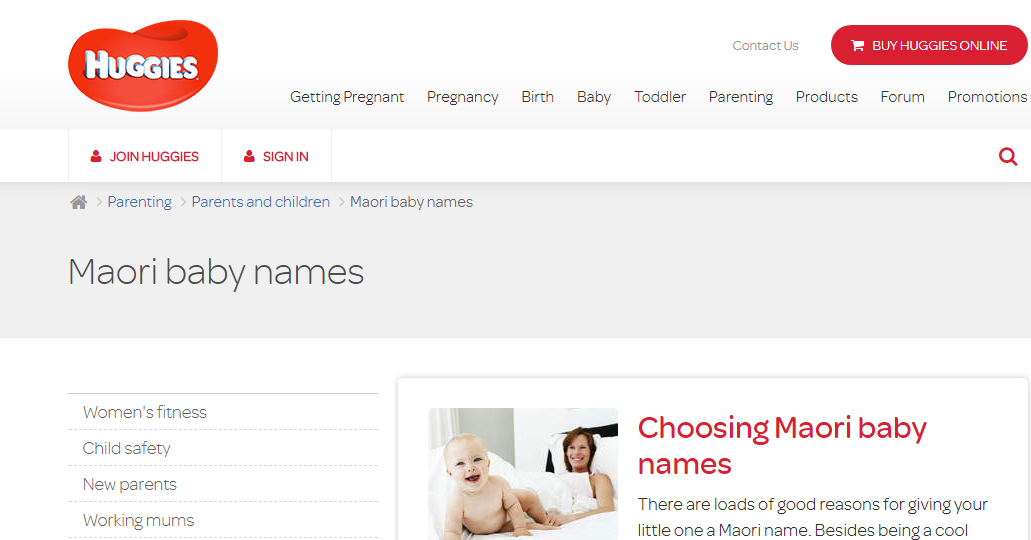
HuggiesNZ a trusted brand for new parents is an example of a corporation discriminating against Māori with little or no disregard to the long term implications for individuals, cultures and laws. Their advice, if followed, could cause irreversible damage to children and parents.
Prior to December 29 2008, or over 10 years prior to writing this article, Huggies New Zealand published a misleading, culturally offensive and linguistically incorrect page of advice for Māori baby names. This page included a Chiefs name and an ancestor of Ngāi Tahu as a suggested baby name with the translation of “pickled youngest child”. It is not clear if this was a reference to the youngest child being drunk or preserved.
About February 2013 or 5 years ago, the page was updated with more pages and sections that included several misleading, culturally offensive and linguistically incorrect pages of advice (label: Expert Advice) for naming a baby with a Māori name. Suggestions include god names, a non Māori name, incomplete translations and racist advice.
Despite several efforts over a period of about 13 months, to contact Huggies New Zealand, including a public Tweet, there has been no response and subsequent HuggiesNZ tweets after. I have not been blocked and my tweet is still public. I have simply been ignored. Hence, this article. 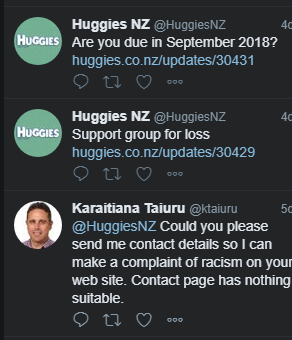
Statistics
It could be argued that Huggies New Zealand do not care about Māori as they are the minority in the market of nappies consumers. StatsNZ data states that between 2012 and 2014 there were 184,595 babies born, of which 155,588 were European and 12,909 were Māori.
Orthographic conventions
The first obvious lack of cultural knowledge on the Huggies pages is is the lack of correct orthographic conventions in the heading of the Māori names page. This is followed throughout all subsequent pages. There are no macrons on the words Māori ). Microsoft have bundled Māori editing tools with Windows for many years and browsers have been able to read macrons for about 18 years.
Religion
Huggies New Zealand implies that Christian religion is far more superior than Māori religious beliefs. Suggestions for baby names include God names such as Mahuika, Rongo, Tangaroa, but names like Jesus Christ or Messiah are not mentioned and are in fact not able to be registered by the New Zealand Department of Internal Affairs. Rua is also suggested as a baby name and referred to as the translation for the word lake. Rua is a shortened and common version of the god of earthquakes – Ruamoko.
Transliterations of common bible names are not included for consideration. Two that are included are offered with different meanings. Matiu and Rawiri are suggested as a boys names. Matiu is provided with a translation of “gift from god” and no information about it being commonly used as a transliteration for Mathew. Rawiri is suggested with a translation “beloved’ and not its common transliteration for David or even as a popular surname.
On their page with suggestions and advise about Māori baby names are a number of culturally ignorant and offensive recommendations .
Non Māori names and bad translations
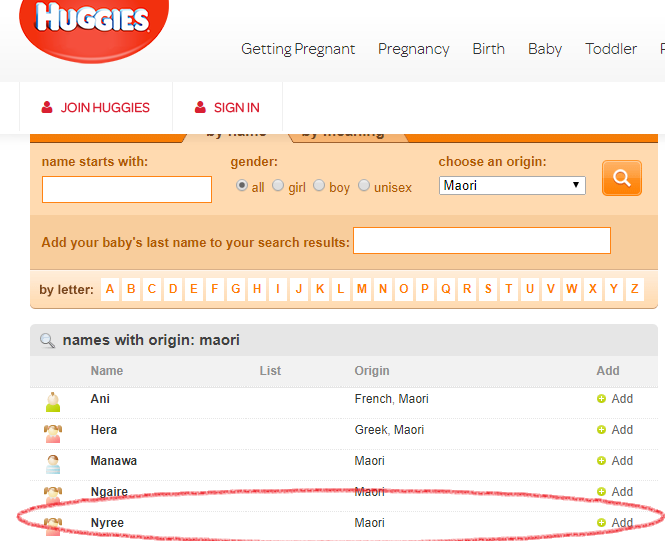
Huggies New Zealand offer a Māori baby name that is linguistically not a Māori word as it contains a character that is not in the Māori alphabet ‘y”. Huggies New Zealand suggests that ‘Nyree” is a Māori girl name . The original mistake was from the 2008 page which stated Nyree is Maori name made popular by NZ actress Nyree Dawn Porter.
Incorrect or incomplete translations of names are offered to unsuspecting parents looking for a baby name. Ahurewa is offered as a name with a translation of “sacred place”. The full meaning not stated on Huggies New Zealand web site includes, expert religious person who is knowledgeable in all of the higher realms of religion. The Pākehā equivalent of the Pope, priest, or other high ranking religious leader.
Another sign of a total lack of respect and understanding of Māori names, Huggies New Zealand states “Also see New Zealand’s popular baby names for another list of Maori baby names”, despite the list containing no Māori names .
Racism
New Zealand legally recognizes two spoken languages and one of them is Māori. New Zealand has legal commitments to the Treaty of Waitangi and the Māori language which is a taonga. The statement to not use a hard to pronounce name is giving people an excuse to be ignorant of the Māori language and of society’s commitment to the Treaty. In most cases, a New Zealander would find a Māori name hard to pronounce if they are culturally ignorant and or a racist. The statement by Huggies New Zealand promotes and supports racism and cultural ignorance.
Culturally offensive advice includes:
- Not using a Māori name that is too hard to pronounce as the child might get teased? Is the name easy to pronounce?
- That the Māori name should flow with the surname.
Huggies New Zealand suggests that a Māori name flow with a surname? This suggestion is obviously written by someone with no knowledge of te ao Māori. A Māori name usually has some whakapapa to it and as the name is associated to a surname also with whakapapa, then it will naturally flow and be correct.
Also on the same page are culturally ignorant statements:
- Avoid embarrassing abbreviations and initials. Can the name be shortened or twisted to something icky, sticky, or illegal? Do the initials spell out a rude word?”
- Do you understand the meaning of the name? Is the meaning kind and respectful, or at least not offensive to others or your child? I.e. won’t cause any embarrassment or shame later in life. Remember those kids at school who got teased or, worse, bullied, because of an unfortunate choice of names by Mum and Dad? Don’t do that to your little one!
- Lastly, are both sides of the family okay with the name?”
Again, a Māori name usually has whakapapa and becomes a part of whakapapa making the above suggestions irrelevant.
The pages do not contain statements that use terms of respect for Māori family values commonly taught at New Zealand schools. Huggies New Zealand use the term “Talking to gran and family”. Again, this lacks knowledge of Māori family terms and the use of the Māori language as terms such as ‘whānau” that are common in New Zealand English.
Disclaimer
Despite Huggies New Zealand making the following statement, their advice, if followed, will cause irreversible damage to children and parents who use the names suggested on the web site.
“Do you understand the meaning of the name? Is the meaning kind and respectful, or at least not offensive to others or your child? I.e. won’t cause any embarrassment or shame later in life. Remember those kids at school who got teased or, worse, bullied, because of an unfortunate choice of names by Mum and Dad? Don’t do that to your little one!”.
Huggies New Zealand web site disclaimer (which is difficult to find and visually see), reflects the lack of effort and care about their advice (spelling mistake is included unedited from their site). It is unfortunate that the corporate Huggies New Zealand could not invest time and money into taking their own advice and seek the advice and opinions of Māori language speakers and people knowledgeable in tikanga Māori. Furthermore, Huggies New Zealand suggest that only fluent Māori speakers could be consulted which contradicts a Māori world view of Māori names as it suggests only fluent speakers are familiar with whakapapa.
“Huggies® (and any healthcare professional, where relevant) intend for the information on this website to be up to date, timely and accurate but, to the extent that we are permitted by law, do not accept any liability or responsibility for claims, errors or omissions.”
The only worthy advise on the site, and if HuggiesNZ followed their own advise there would not be any isses “there are loads of excellent English/Maori dictionaries online or talk to someone who is fluent in the language and/or knowledgeable in tikanga Maori”.
Conclusion
Appropriate advice for naming a baby with a Māori name include consulting your whānau, history and your own whakapapa. If you are non Māori, then consider using common translated names form the Bible or Book of Mormon or consulting local Māori and multiple dictionaries of the Māori language.
Update
After writing my story about Huggies New Zealand (owned by international company Kimberly-Clark Corporation) and their incorrect and offensive baby names advise on their web site, I contacted Radio Waatea who very professionally and neutrally interviewed me on the topic on March 08 . I too was cautious with my wording on this very serious matter.
Afterwards, I sent one tweet with the text “NZ Corporate ignorance of Māori. Disrespectful and harmful baby names advice via @HuggiesNZ “. The intention of the tweet was to give yet another opportunity for a response. I know that in order to protect a brand name social media is monitored, though I was not too sure about Huggies as they had ignored me on Twitter.
On March 12 2018, I missed a phone call from an Australian number. Later when I checked my voice mail it was a message from the Customer Care Manager (Australia) of Kimberly-Clark Corporation the international corporation for a number of brands including Huggies. Due to a busy schedule I did not ring back that day. On March 14 2018, I missed another phone call as I was on the other line. I rung back to the service desk in Australia using the 0800 number and said who I was and asked for the person by name. To my surprise, the person on the other end of the phone said “Yes Mr Taiuru, person is expecting your phone call but she is away from her desk, can she call you back”. At this stage I have noted two things. The genuineness of the company to ring me twice and that the call desk operator knew my name and was expecting me.
During the return phone call the fact that Kimberly-Clark Corporation did not want to offend anyone was reiterated several times during the 6 minute phone call.
I was told that the Twitter account @HuggiesNZ referenced in my article was in fact not authentic, despite having the Twitter blue tick of authentication. If I had not have gone public with my complaint, the rouge Twitter account would still be operating as the company had no idea up till the article and media interview of the account. The authentication of the fake twitter account had been removed when I checked after the phone call. Strangely several Twitter comments referring to HuggiesNZ as being racisit by other people were also removed. The account is still active and has at the time of writing not been canceled or suspended. More information in the Twitter Terms.
The pages have been temporarily taken down while they can be reviewed and updated by an expert. I was also informed that there is in fact an Auckland office of Huggies. I offered two names as experts, an organisation and a licensed Māori language interpreter.
The real success of this story is that expectant parents will no longer be subject to bad advice and incorect Māori names and meanings when they name their new born babies.
Lessons learnt as an individual voice taking on an international conglomerate:
- Don’t be afraid to defend your culture and step outside of our comfort zone.
- Plan how to go public and be patient.
- Utilise social media in a positive manner. Start small, then try to saturate your networks if needed.
- Be persistent and consider that large international corporations are large and complex and that it is likely that your lone Indigenous voice may not get to the decision maker straight away.
- Be courteous and professional at all times. Two negative attitudes do not make a successful relationship. It is doubtful that the decision makers knew and planned to make something offensive. If they did, then your minority group must have some wide spread recognition and be feared by the corporate.
- Be co operative if you are contacted, but be cautious so as your intentions are not questioned. If you complain and then offered to be paid to fix the issue could have the impression that was the intent in the first place.
3 thoughts on “Huggies New Zealand – culturally offensive with Māori baby names”