This article explores a proposed Māori led framework for datacentre development. Using a Māori owned and developed framework using environmental protections that are interwoven in tikanga Māori that respect and utilise the New Zealand environment. It argues that by doing so, New Zealand could sustainably cater to the development of AI and Data centres.
This article builds on the video by Dr Karaitiana Taiuru called Papatūānuku at https://www.youtube.com/watch?v=IqEiB4JsPog
Introduction
New Zealand is entering a period of potential significant data centre expansion, driven by Artificial Intelligence, cloud computing and rising digital demand.
The environmental debate is often reduced to electricity and water. Data centres occupy land, consume resources, generate heat, require hardware and backup systems, place demands on electricity networks, and affect freshwater and marine environments.
For Māori, these impacts cannot be understood solely through litres, megawatts or acres. Water, land and the ocean have intimate whakapapa, relationships and cultural significance.
The Resource Management Act 1991 recognises, as a matter of national importance, the relationship of Māori and their culture and traditions with ancestral lands, water, sites, wāhi tapu (scared sites) and other taonga, and requires particular regard to kaitiakitanga.
The National Policy Statement for Freshwater Management 2020 (NPS) also establishes Te Mana o te Wai and principles for freshwater management. However, following the Resource Management (Freshwater and Other Matters) Amendment Act 2024, the Te Mana o te Wai hierarchy of obligations is currently excluded from resource-consent decision-making, even though it remains part of NPS framework.
Sustainable design is therefore not simply corporate goodwill. The question is whether Māori and environmental considerations determine the location, architecture, resource inputs, operating limits, ownership opportunities and end-of-life obligations of infrastructure from the beginning, rather than being added after the fundamental design has been fixed.
The Social Media Irony
There is an unavoidable irony (the author has been subject to some negative commentary) in using social media to campaign about data centres. Meta, Google, TikTok, YouTube and other platforms all depend on extensive Data Centre and cloud infrastructure. The infrastructure is not confined to the United States but data is distributed across international networks of company-owned data centres, cloud providers and telecommunications networks.
Data centres in New Zealand
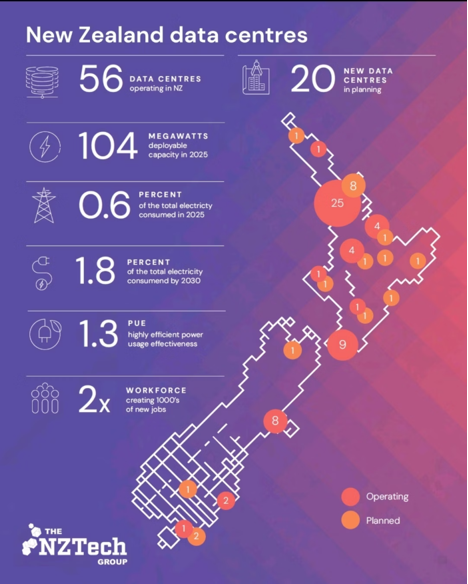
Source: Empowering Aotearoa New Zealand’s Digital Future – Our National Data Centre Infrastructure (NZTech, 11 Sept 2025)
The Environmental Problems
Cooling is a major contributor to energy demand, particularly where conventional evaporative cooling is used. Water reporting should distinguish between water authorised to be taken, abstracted, consumed, recycled internally, discharged and peak rather than average demand.
A facility may have a large permitted take while using much less; conversely, a low annual average can still place significant pressure on a catchment through peak abstraction.
For Māori, these measurements are necessary but insufficient. The question is also: whose water, land and ocean, and whose relationship with that environment is being affected?
The preferred hierarchy should be:
- Avoid unnecessary computing demand
- Choose a low-impact site
- Minimise freshwater dependence
- Use closed-loop and reclaimed water systems
- Recover waste heat
- Match electricity demand with renewable energy
- Design for repair, reuse and material recovery
- Use desalination, deep-water cooling or ocean infrastructure only where site-specific evidence shows they cause less overall harm.
1. Reduce the Need for Data-Centre Capacity
Measures include smaller models where appropriate, model distillation, efficient inference, improved server utilisation, workload scheduling, data deduplication, storage tiering, extending hardware life, avoiding unnecessary computation, and shifting flexible workloads to periods or locations where renewable electricity is available.
Electricity consumption per unit of AI computation is generally falling as hardware and software efficiency improve, but aggregate electricity demand can continue to rise as AI deployment, model size, utilisation and applications expand.
New Zealand should therefore assess not only how efficiently a facility operates, but whether the computing activity itself is being delivered efficiently.
2. Site Selection Is an Environmental Technology
A low impact site should have low freshwater stress, minimal ecological sensitivity, low risk to wāhi tapu and sites of significance, existing industrial infrastructure, access to renewable electricity, sufficient grid capacity, access to treated wastewater where practical, nearby users for recovered heat, suitable fibre connectivity, low flood and sea-level-rise risk, and a credible decommissioning pathway.
This is preferable to selecting a site for commercial reasons and then engineering away its disadvantages.
A Māori-led site assessment should occur before the site is effectively determined, not after a preferred location has been chosen.
3. Reclaimed and Non-Potable Water
Google has reported that it uses reclaimed or non-potable water at more than 25% of its data-centre campuses at Douglas County, Georgia where wastewater is recycled for cooling rather than being discharged directly to the Chattahoochee River.
Microsoft’s water-reuse system in Quincy, Washington, has reduced potable-water use by approximately 97%, making approximately 1.5 million cubic metres of reclaimed water available annually for community use.
For New Zealand, the principle should be that drinking water and environmentally sensitive groundwater should not be the default cooling source for a hyper scale data centre where a suitable reclaimed source exists.
Reclaimed water is not automatically neutral, treatment requires energy, pipelines and chemicals, and the resulting water still needs an appropriate end-of-life pathway. Any proposal should demonstrate the complete water cycle, not simply identify an alternative source.
4. Closed-Loop and Low-Water Cooling
Closed-loop cooling should be the starting point for new high density facilities. Coolant is circulated through the equipment and heat exchangers rather than continually consuming freshwater through evaporation, and modern direct-liquid cooling is particularly relevant to high-density AI hardware.
The design objective should be to minimise consumptive freshwater use, not only to maximise cooling efficiency. A consent framework should require disclosure of annual freshwater withdrawal, annual freshwater consumption, peak abstraction, reclaimed-water use, wastewater discharge, cooling-system type, and projected water use under maximum operating conditions.
Data Centre Wastewater Treatment Symbiosis
A data centre needs cooling and produces continuous low-grade heat; a wastewater treatment plant produces treated effluent and has processes that can use recoverable heat.
A 2026 peer-reviewed global analysis modelled more than 4,775 data centres and 57,547 municipal wastewater treatment plants across 98 countries. It estimated that large-scale data–water symbiosis could conserve approximately 1.3 billion cubic metres of freshwater and reduce approximately 84 million tonnes of CO₂-equivalent emissions annually, with most beneficial pairings within 40 km. The study is a global systems model rather than evidence that every proposed data centre/wastewater pairing will be technically or economically viable.
It should be noted that these are global modelled results, not predictions for New Zealand.
A new data centre should be required to demonstrate whether co-location with a wastewater treatment facility is feasible before seeking permission to take substantial quantities of potable water or groundwater.
The cultural question still remains essential. Treated wastewater must still be managed in accordance with the values and requirements of the relevant catchment and mana whenua/kaitiaki of the land. The purpose is to reduce harm to water, not simply move the discharge point.
Waste Heat
Almost all electricity a data centre consumes ultimately becomes heat. The challenge is that it is difficult to use directly without a heat pump. But because the heat is continuous, the opportunity is substantial.
Meta’s Odense data centre in Denmark is designed to recover approximately 165,000 MWh of heat annually, enough to help warm about 11,000 homes. That model works partly because Denmark has extensive district heating. New Zealand should therefore pursue more localised applications: glasshouses, aquaculture, food processing, timber drying, industrial process heat, wastewater treatment, marae, papakāinga, community facilities and suitable housing developments.
A consent condition should require every large data centre to identify credible heat-reuse opportunities within a defined radius and explain why recovery is impracticable where none is proposed. Recovering heat is preferable to treating an awa or moana as a heat sink.
Renewable Electricity
A large data centre should demonstrate new renewable generation contracted or co-developed, adequate firming and storage, grid-impact management, transparent consumption, demand-response capability where practical, and a credible relationship between new demand and new supply.
New digital demand should help bring forward new clean generation rather than simply consuming existing capacity and leaving the wider system to compensate.
Renewable generation must itself be assessed through the same environmental and Māori frameworks.
Geothermal Energy
Geothermal energy can provide direct heat for suitable industrial or agricultural applications and, where temperatures and system economics permit, potentially support thermally driven cooling.
GNS Science notes that land and associated geothermal resources have, under Te Tiriti arrangements, been returned to iwi ownership and developed through Māori land trusts and businesses. Ngā Awa Pūrua is an example: the 139 MW geothermal station is jointly owned by Tauhara North No.2 Trust (35%) and Mercury (65%).
Not that all geothermal resources are Māori owned, but that where iwi or Māori trusts own land, geothermal interests or enterprises, development can be structured around Māori ownership, investment and decision-making rather than mere consultation.
Solar Power
On site or nearby solar can reduce daytime grid demand, particularly on roofs, parking structures, already-modified industrial land, and land of low ecological and cultural sensitivity. It is unlikely to supply the continuous demand of a hyper-scale AI facility alone, so its role should be complementary to geothermal, wind, hydro, storage and grid supply.
The same land use test applies: a project is not sustainable merely because the energy is renewable; its effects on land, biodiversity, landscape, mahinga kai and wāhi tapu must also be assessed.
Waste to-Energy
Biogas and landfill gas recovery can have a legitimate role capturing methane that would otherwise be emitted and using it for electricity and heat, reduces emissions and recovers energy from an existing waste stream.
Cold Climate and Deep-Water Cooling
Southland shows the value of a climate that naturally reduces cooling requirements. The Makarewa case illustrates why consented capacity must not be reported as actual environmental consumption.
Environment Southland granted Datagrid a groundwater consent allowing up to 7 Ltrs and 220,752 m³/year, while Datagrid subsequently stated in July 2026 that it expected to draw no groundwater during operation because of the site’s climate and proposed reliance on free-air cooling. Actual abstraction therefore needs to be independently metered and publicly reported.
Environmental reporting should separate consented capacity, actual abstraction, actual consumption and actual discharge, and the Makarewa example shows why continuous public metering and reporting should be a condition of large consents.
Deep cold seawater can also provide low-energy cooling, but the marine environment must not automatically be treated as a heat sink. Any intake and discharge would need assessment of temperature, salinity, marine ecology, biofouling, cumulative effects and cultural values, with the relevant mana whenua and mana moana involved from the beginning.
Ocean Sited Servers
Microsoft’s Project Natick demonstrated that sealed subsea modules could be deployed and operated underwater, reporting a server failure rate about one-eighth that of its land-based control group. China has now moved to commercial-scale subsea deployment, with a Shanghai underwater project linked to offshore renewable generation in 2026.
Potential advantages include reduced land occupation, reduced freshwater demand, efficient heat transfer to seawater and potentially lower cooling energy, but these do not make the ocean environmentally neutral.
Potential impacts include thermal effects, marine habitat disturbance, construction and cable impacts, biofouling, maintenance and retrieval, marine pollution and cumulative effects on sensitive ecosystems
For New Zealand, ocean-sited data centres should be treated as an experimental or highly site-specific option, not a default sustainability solution. The ocean is a living environment with whakapapa, mauri, mahinga kai and cultural significance. Many of these can be addressed with tikanga Māori and traditional knowledge.
Desalination
Desalination can reduce pressure on freshwater in coastal areas, but it does not eliminate environmental impacts. Reverse-osmosis desalination requires significant energy and produces concentrated brine and returning that concentrate to the ocean can create local salinity and ecological effects. It should be treated as a last-resort water source.
The preferred hierarchy is to reduce water demand; use closed-loop cooling; use reclaimed municipal wastewater; use rainwater or other suitable non-potable sources; and only then consider desalination where necessary. Where desalination is proposed, the developer should investigate energy demand, renewable supply, brine minimisation, salt/mineral recovery, ecological effects, discharge alternatives and cumulative marine effects.
Halophyte Brine Treatment and Living Systems
Halophyte brine refers to the highly concentrated salt water produced during desalination that is managed, treated, or repurposed using salt-tolerant plants called halophytes.
A 2025 peer-reviewed study cultivated halophytes using brines from brackish-water desalination found potential for plant growth and salt accumulation, suggesting a pathway for biological brine treatment and resource recovery. It does not establish that constructed wetlands can safely absorb the full hypersaline concentrate from a seawater desalination plant at commercial scale.
A pilot could investigate halophyte cultivation (trials with taonga species), salt recovery, biomass production, nutrient removal, controlled evaporation, aquaculture integration where appropriate, and eventual treatment of residual concentrate.
For Māori, its potential value lies in a managed living system designed to keep pollutants and concentrated salts out of the moana, but it must be engineered, monitored and maintained over time.
Recycling Hardware
A data centre’s environmental footprint begins before the server arrives and continues after is purposes are completed.
Microsoft reported a 90.9% reuse and recycling rate for servers and components in 2024, and more than 3.2 million components reused through its Circular Centre programme that year; it is also investigating recovery of rare-earth materials from hard drives. Global e-waste shows about 62 million tonnes were generated in 2022, of which only 22.3% was formally collected and recycled. The current 2026 Microsoft material sometimes describes the hardware metric as 92%, apparently reflecting a revised/current reporting methodology, while Microsoft’s FY24 sustainability report clearly gives 90.9%
A consent should require a hardware circularity plan covering expected server life, repairability, component reuse, refurbishment, secure redeployment, battery recovery, circuit-board recovery, rare-earth recovery, certified recycling, data destruction and final disposal.
Recycling is only one part of circularity; extending useful life through repair, refurbishment, component reuse and redeployment can often preserve more of the embedded material and manufacturing value than recycling alone.
A Māori-Led Decision Framework
The following is a proposed Māori-led governance standard that goes beyond current minimum statutory requirements. Each consideration should also ask the impacts of the mauri.
Water/Wai
What water source will be used? How much is authorised, expected to be abstracted, and consumed? What will be discharged? What happens during drought or low flow? Is reclaimed water feasible?
Whenua
What land will be occupied? Is it already modified? Are wāhi tapu, archaeological sites or culturally significant landscapes affected? What biodiversity will be lost or restored?
Moana
Is seawater required? Is there a marine discharge? What temperature and salinity changes will occur? What are the effects on mahinga kai? What cumulative effects exist?
Energy
What is peak electricity demand and annual consumption? What new renewable generation is associated with the project? What storage or firming is available? What is the local grid impact?
Heat
How much heat will be produced, and at what temperature? Who could use it? Has a heat network been considered? If heat is not recovered, why not?
Materials
How long will servers remain in service? What proportion will be reused and recycled? How will batteries and critical minerals be recovered?
Māori decision-making
Who are the relevant mana whenua and rights-holders? Were they involved before site selection? What decisions are subject to genuine co-design or Māori authority? Are there opportunities for ownership, investment and procurement? How will mātauranga Māori be protected, and how will cultural monitoring occur over the life of the project?
Taonga Species
What Taonga Species will be impacted on land and in water. What tikanga can be applied to move them and or to compensate the moving of Taonga Species?
A Proposed New Zealand Data-Centre Standard
For hyper scale data centres, the following should be considered:
- Mana whenua/Kaitiaki engagement before final site selection
- A cultural values assessment where appropriate
- A water-source hierarchy demonstrating why lower-impact sources are unavailable
- Maximum freshwater abstraction limits
- Public reporting of actual water abstraction and consumption
- Peak water-demand disclosure
- Closed-loop or low-water cooling as the default
- Reclaimed-water feasibility assessment
- Data centre/wastewater-plant symbiosis assessment
- Waste-heat recovery assessment
- Renewable-energy
- Grid-impact and firming plan
- AI/computing efficiency assessment
- Hardware circularity plan
- Biodiversity and whenua protection plan
- Māori procurement, employment and ownership opportunities where appropriate
- Long-term environmental and cultural monitoring
- Independent auditing
- Financial security for decommissioning and environmental restoration.
Embedding explicit Kaitiaki and mana whenua governance options moves Māori participation from consultation to co-authority over the project’s most consequential decisions. In practice, this can be structured through joint venture ownership of the data centre or its enabling infrastructure (for example, a special-purpose vehicle that holds the land, cooling assets or renewable generation), with mana whenua holding meaningful equity stakes and board representation.
Procurement levers can be built into the consent or investment agreement, such as minimum targets for Māori-owned businesses in construction, operations, security, landscaping and hardware logistics, alongside training and employment pathways for local rangatahi.
Governance should include veto or co-decision rights on defined environmental thresholds: for instance, no increase in peak freshwater abstraction beyond an agreed limit, no operation without a credible waste-heat user, or the ability to pause or curtail operations if cultural monitoring shows unacceptable impacts on wāhi tapu, mahinga kai or taonga species. This transforms Māori input into a binding constraint on project architecture rather than an advisory layer added after design.
A large hyperscale facility should be required to publish a grid impact study that models peak and average demand, local voltage and stability effects, and the need for network upgrades, with costs and timelines clearly allocated.
This should be paired with a firming and storage plan that shows how the load will be matched by additional renewable generation and firm capacity (for example, geothermal, hydro, batteries or demand-side response), rather than relying on the existing system to absorb the new demand.
Conclusion
New Zealand can build the digital infrastructure it needs without reproducing an extractive model of development. Technologies and design practices already exist that can substantially reduce particular data centre impacts, although their feasibility and environmental benefit are site-specific.
Efficient computing can cut unnecessary capacity; careful site selection can avoid conflict before it begins; closed-loop and direct-liquid cooling can reduce freshwater demand; reclaimed wastewater can replace potable water; wastewater plants can be paired with data centres; waste heat can support horticulture, aquaculture, industry and community facilities; geothermal can provide continuous renewable energy where the resource can sustainably support extraction; wind and solar can add generation; hardware can be repaired, reused and recovered; desalination can be reserved for where lower-impact sources are unavailable; and marine and subsea technologies can be considered only where their total ecological impacts are demonstrably acceptable.
The fundamental issue is governance. A data centre is not simply a building containing computers; it is an industrial system connected to electricity networks, water systems, wastewater infrastructure, land, telecommunications, material supply chains and communities.
The goal is therefore neither to prevent all development, nor to accept it on the assumption that economic benefits outweigh environmental and cultural costs. It is to build a New Zealand model of data-centre infrastructure: low-water, renewable, circular, heat-recovering, strategically located, transparent, environmentally accountable, and designed with mana whenua from the beginning.
Environmental sustainability and Māori interests should not be competing add-ons to digital infrastructure. They should shape where it is located, how it operates, what it consumes, what it returns to the community, who benefits, and how it is eventually removed.
A sustainable data centre is not one that adds environmental features to a predetermined project. It is one whose location, architecture, resource use, ownership and operating limits are shaped by the obligation to protect the taonga and relationships of the place in which it operates.
References
1News. Southland community has questions about $3.5b AI data centre, 24 July 2026.
Environment Southland. Datagrid NZ Partnership Limited — Resource Consents, 2026.
Environment Southland. Water Permit AUTH-20252550-03, 2026.
GNS Science / Earth Sciences New Zealand. New Zealand’s history of geothermal energy.
Google. Our commitment to climate-conscious data center cooling.
IEA. Energy and AI. 2025.
Kalboussi et al. Harnessing halophytes to mitigate the environmental impact of membrane desalination brine. Journal of Environmental Management, 387, 125780, 2025.
Mercury. Ngā Awa Pūrua Geothermal Power Station.
Meta. We are expanding the Odense Data Center.
Microsoft Research. Project Natick.
Microsoft. 2025 Environmental Sustainability Report.
Microsoft. Understanding water use at Microsoft datacenters.
Ministry for the Environment. Exclusion of the hierarchy of obligations from resource consenting. 2024.
Ministry for the Environment. National Policy Statement for Freshwater Management 2020, consolidated 15 January 2026.
Ministry for the Environment. Resource Management (Freshwater and Other Matters) Amendment Act 2024.
New Zealand Legislation. Resource Management Act 1991, ss 6(e), 7(a).
New Zealand Parliament. Planning Bill and Natural Environment Bill — current parliamentary status as at 30 August 2026.
Shanghai/Lingang authorities / contemporary reporting on the 2026 underwater data-centre project.
Waitangi Tribunal. Ko Aotearoa Tēnei: A Report into Claims Concerning New Zealand Law and Policy Affecting Māori Culture and Identity — Wai 262, 2011.
Waitangi Tribunal. National Freshwater and Geothermal Resources Inquiry — Wai 2358.
Wang et al. Global data–water symbiosis reduces AI infrastructure’s carbon and water footprint. Environmental Science and Ecotechnology, 31, 100702, 2026.
WHO. Electronic waste (e-waste), 2024.