This is an historical case study from 2020 that is used here as an important example. ANZ Bank’s automated voice and the mispronunciation of Ohakune. It should be noted here that after the individual made a complaint directly, the issue was rectified.
ANZ Bank New Zealand’s automated telephone system mispronounced Ohakune, a Ngāti Rangi place name, as an anglicised word, and rejected the name when a caller pronounced it correctly.
The author used as an example in evidence before the Waitangi Tribunal in the WAI 2252 (Wai 2522, 2020) (Taiuru, 2020a).
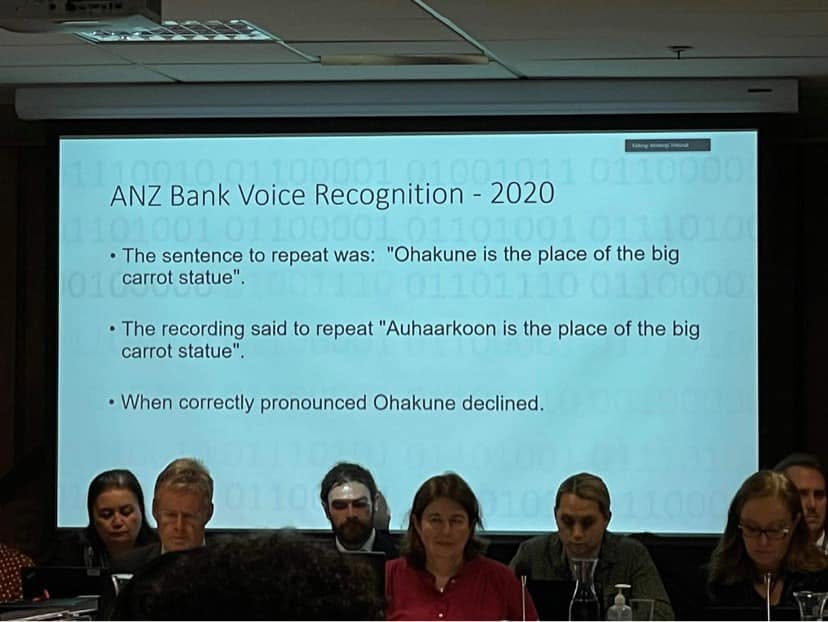
The error was built into a machine voice and repeated to every caller. It shows how automated systems can turn mispronunciation of te reo Māori from a habit into infrastructure, and why that highlights the need to engage with the appropriate Māori communities for advise. Yes, it may cost a little in terms of time and finances, but it also reduces the organisation risks which may outweigh the initial investment.
What happened
The phone system asked the caller to repeat a set sentence: “Ohakune is the place of the big carrot statue.” The system’s own voice read the sentence aloud as “Auhakaroon is the place of the big carrot statue.” When the caller repeated the sentence with Ohakune pronounced correctly, the system declined it.
Today I had to do voice verification for phone banking in ANZ. The sentence I had to repeat was: “Ohakune is the place of the big carrot statue”.
That recording actually said for me to repeat “Auhaarkoon is the place of the big carrot statue”.When I correctly pronounced Ohakune I was unable to proceed.When I put on the “other” voice which mangled the word..I got throughI am making a complaint right now.
Edit: ANZ made it right.
The anglicised form is a familiar one. It collapses the final syllable and turns the “u” into an English “oo” sound. In a person, that is a correctable habit. In a synthetic voice, it is a fixed output repeated to every customer who hears it. And when the same system rejects the correct pronunciation, the burden of the error shifts to the Māori speaker, who must mispronounce a Māori name to be understood.
The case shows two things: how easily such a mistake is made without consultation, and how a cultural inaccuracy can be reinforced and perpetuated, without any intent to do so, when Māori authorities are not consulted.
Whakapapa of Ohakune
Ohakune is a Ngāti Rangi name, and its meaning comes from Ngāti Rangi kōrero. The iwi trace it to the phrase “e oha, ka oha, he Ohakune ki te ao”, an opening to a new world. It describes the descent from Ruapehu out of the forest into open grasslands and swamps (Waatea News, 2019).
In 2019 the New Zealand Geographic Board made the name official as Ōhakune, with a macron, without consulting Ngāti Rangi. After the iwi objected, the Board reverted to Ohakune on 29 July 2019 (NZ Herald, 2019; RNZ, 2019).
The point for this case study: authority over how a place name is written and spoken sits with mana whenua. It does not sit with a Crown board, a dataset, or a vendor’s speech engine. In the same period that the Crown was being corrected on this exact name, a major bank’s machine voice was still getting it wrong.
ANZ’s voice technology
Between 2017 and 2021 ANZ New Zealand built its phone channel around automated speech. Apart from a 2018 statement that some te reo Māori would be added to its digital assistant, none of the public material on these systems mentions te reo Māori, Māori place names or Māori speakers.
2017 – Voice ID launch
Biometric voice authentication, developed with Nuance (ANZ, 2021).
2018 – Speech-recognition IVR
A one-question natural-language IVR replaced the press-a-button menu: 69% success at launch, 75% after tuning (Cyara, 2018).
2018 – Jamie digital assistant
Built by Soul Machines. ANZ said it planned to add some te reo Māori to her vocabulary (NZ Herald, 2018; The Post, 2018).
2021 – Voice ID update
815,000 customers enrolled, about 50% of contact-centre callers using it. Voiceprints capture “accent, pronunciation and the way each person emphasises words” (ANZ, 2021).
The wider context
ANZ’s error occurred in the same years that machine mispronunciation of Māori names was becoming a public issue.
September 2017 – Say it Tika.
Vodafone, Google and Te Taura Whiri i te Reo Māori ran Say it Tika: the public pinned 9,598 unique mispronounced place names on Google Maps for correction (Cannes Lions, n.d.; RNZ, 2017).
Relevance: proof that corporates could fix this with Te Taura Whiri.
January 2020 – Alexa and Taumatawhakatangihanga.
Amazon’s Alexa mangled the name in a viral video (Te Ao Māori News, 2020).
Relevance: public awareness of machine mispronunciation in the same period.
April 2021 – Rangiora radio advertisement
The Advertising Standards Authority upheld a complaint about a radio advertisement that mispronounced Rangiora, finding it disrespectful and harmful to te reo Māori (AJ Park, 2021).
Relevance: mispronunciation in commercial audio recognised as harm, not style.
Te Tiriti analysis
Te reo Māori is a taonga guaranteed under Article 2 of Te Tiriti o Waitangi, and a machine voice that distorts it engages that guarantee.
Active protection (Wai 11). The Tribunal found that the Treaty requires affirmative action to protect and sustain the language, not a passive obligation to tolerate its existence (Waitangi Tribunal, 1986). ANZ is not the Crown. But the Crown’s duty of active protection extends to the conditions it allows in regulated sectors such as banking, and an automated national voice is one of those conditions.
Māori data (Wai 2522). The Tribunal defines Māori data as digital or digitisable information or knowledge about or from Māori people, language, culture, resources or environments. The pronunciation rules and lexicon a speech engine uses for Ohakune are Māori data. Who sets them, and with whose authority, is a Māori data sovereignty question, not a technical setting.
Digital colonisation. My 2020 Te Tiriti and Māori ethics guidelines set out criteria for digital colonialism (Taiuru, 2020b). An offshore-tuned speech engine that imposes English phonology on a Māori name, at national scale and without Māori input, fits that pattern.
Architecture versus decoration. ANZ’s 2018 promise to add te reo Māori to Jamie was decorative: words in an assistant’s vocabulary. The phone voice is architecture: the system every caller hears. The test is whether Māori provisions shape the architecture. In this case they did not.
What good looks like
In July 2026 Google Maps launched a New Zealand voice that pronounces te reo Māori place names correctly.
- Māori expertise in the build: Te Taura Whiri linguists worked alongside Google engineers over several years (Taiuru, 2026).
- Kaitiakitanga of the data: Te Taura Whiri will initially be kaitiaki of the Māori lexicon, with a wider group of custodians planned (Geekzone, 2026).
- A correction channel: the public can report mispronounced names to Te Taura Whiri so the model can be retrained (Scoop, 2026).
The rules draw on New Zealand Geographic Board data, and Ohakune shows that Board data can be wrong when mana whenua are not asked. Iwi and hapū, not only a national body, need a route to correct their own names.
Lessons
Any organisation that puts a synthetic voice in front of New Zealanders should treat te reo Māori pronunciation as a governance requirement, not a tuning task.
- Test before launch. Test Māori place name, street name and personal name the system can say past fluent speakers before it goes live.
- Take pronunciation from mana whenua. Use iwi and hapū sources for their own names; do not rely on a dataset or a vendor default alone.
- Treat the lexicon as Māori data. Agree who holds kaitiakitanga over the pronunciation rules, and record it in the vendor contract.
- Test recognition as well as speech. Confirm the system accepts correct pronunciation from fluent speakers, not only that it produces it.
- Build a correction channel. Let customers report errors, and fix them within a stated time.
- Hold the Loop. Keep a named person accountable for what the machine voice says, under the Human-accountable-for-the-Loop principle.
- Check architecture. Ask whether Māori requirements are written into the system design, or only into the marketing.
References
AJ Park. (2021, June 3). Advertisement pulled due to incorrect pronunciation of Māori place name. https://www.ajpark.com/insights/new-zealand-advertisement-pulled-due-to-incorrect-pronunciation-of-maori-place-name/
ANZ Bank New Zealand. (2021, April). Biometric Voice ID. https://www.anz.com.au/newsroom/new-zealand/2021/04/biometric-voice-id/
Cannes Lions. (n.d.). Say it Tika [Campaign entry]. https://lovethework.com/work-awards/campaigns/say-it-tika-404469
Cyara. (2018, November 14). ANZ: Delivering assured CX. https://cyara.com/blog/anz-delivering-assured-cx/
Geekzone. (2026, July). Google Maps launches a New Zealand voice. https://www.geekzone.co.nz/content.asp?contentid=27362
NZ Herald. (2018). ANZ unveils eerily realistic digital assistant to answer customer questions. https://www.nzherald.co.nz/business/anz-unveils-eerily-realistic-digital-assistant-to-answer-customer-questions/PUD7OW4KKI235TPPJE3ZJNEM6Q/
NZ Herald. (2019). Spelling of Ohakune correct without macron, Ngāti Rangi chair says. Whanganui Chronicle. https://www.nzherald.co.nz/whanganui-chronicle/news/spelling-of-ohakune-correct-without-macron-ngati-rangi-chair-says/WGVU73CHGVCL56TCJODVICGRHA/
RNZ. (2017, September 23). Te reo Google maps a step closer. https://www.rnz.co.nz/news/te-manu-korihi/340046/te-reo-google-maps-a-step-closer
RNZ. (2019). Iwi raises concern after Ohakune spelled wrong officially. https://www.rnz.co.nz/news/national/396022/iwi-raises-concern-after-ohakune-spelled-wrong-officially
Scoop. (2026, July 2). Google Maps launches a New Zealand voice to improve pronunciation of te reo Māori towns [Press release, Te Taura Whiri i te Reo Māori]. https://www.scoop.co.nz/stories/SC2607/S00005/google-maps-launches-a-new-zealand-voice-to-improve-pronunciation-of-te-reo-maori-towns.htm
Taiuru, K. (n.d.). Māori data sovereignty principles. Taiuru & Associates. https://taiuru.co.nz/compendium-of-maori-data-sovereignty/
Taiuru, K. (2020b). Treaty of Waitangi/Te Tiriti and Māori ethics guidelines for: AI, algorithms, data and IOT. https://www.taiuru.co.nz/tiritiethicalguide/
Taiuru, K. (2026, July 5). Māori data sovereignty operationalised with Google Maps. https://www.taiuru.co.nz/maori-data-sovereignty-operationalised-with-google-maps/
Te Ao Māori News. (2020, January 6). Alexa gets Māori wake-up call about world’s longest place name. https://www.teaonews.co.nz/2020/01/06/alexa-gets-maori-wake-up-call-about-worlds-longest-place-name/
The Post. (2018, November 19). Customers flock to question AI banker. https://www.pressreader.com/new-zealand/the-post-1022/20181119/282243781631492
Waatea News. (2019, August 5). Geographic Board too quick to add Ohakune macron. https://waateanews.com/?p=358607
Waitangi Tribunal. (1986). Report of the Waitangi Tribunal on the te reo Māori claim (Wai 11). https://forms.justice.govt.nz/search/Documents/WT/wt_DOC_68482156/Report%20on%20the%20Te%20Reo%20Maori%20Claim%20W.pdf
Disclaimer: AI was used to research historical media articles. Facebook was used to source the quote from the original author and for the photo which was in the authors account.
How to cite this page
Taiuru, K. (2026, November 10). Voice Recognition mispronunciation. Taiuru & Associates Ltd. https://www.taiuru.co.nz/voice-recognition-mispronunciation/