Google in Māori
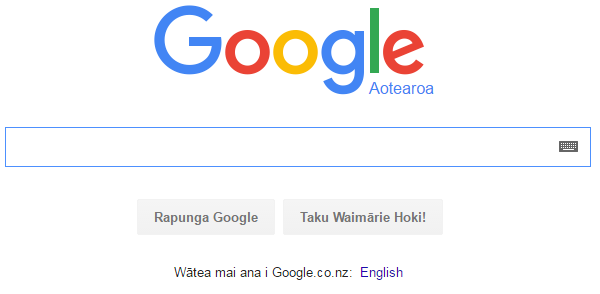
There is also a small (up to 250 people) symbolic launch next week with one of the community of translators.
Initial thoughts thus far, Māori requires a macron and hopefully Google will acquire the domain name google.maori.nz which appears to be cyber squatted at present.
July 23, 2008 Update
One important thing i have noticed that nobody has mentioned, is that there is still a lot of translating left to complete:
AdWords API static documentation (0% complete)
Groups Beta (3% complete)
Main Site Help Pages (10% complete)
Picasa2 (0% complete)
User Distributed Search (xlb) (100% complete)
Wireless (17% complete)
Wireless Transcoder (0% complete) .
Hopefully all of the translators have not lost momentum and will complete the project.
Picasa2 is relatively simple to complete with just over 2700 translations with many of them having already been used in other projects.
It appears as though the Google Translation tools have been made more user friendly.
Sexism
Responding to Stuff.co.nz story about sexism against women titled “Shocking sexism in Google search” I have written about the way Google autocomplete discriminate against Māori.
It is unfortunate that no effort has, nor has ever been made to discuss the racist and offensive auto complete relating to Māori or any other Indigenous Peoples of the world.
I first raised this issue in May 2010. Today the issue is not as bad due mainly to of the mass introduction of authentic Māori information by Māori, Iwi, knowledge workers and academia.
What is the Google autocomplete? Google states, “As you type, auto complete predicts and displays queries to choose from. The search queries that you see as part of auto complete are a reflection of the search activity of all web users and the content of web pages indexed by Google”.
How does the Google Autocomplete work. According to Google “ Autocomplete predictions are algorithmically determined based on a number of factors (including popularity of search terms) without any human intervention. Just like the web, the search queries presented may include silly or strange or surprising terms and phrases. While we always strive to reflect the diversity of content on the web (some good, some objectionable), we also apply a narrow set of removal policies for pornography, violence, hate speech, and terms that are frequently used to find content that infringes copyrights.”
Microsoft Bing www.bing.co.nz does not offer the same offensive and racist auto complete options nor does its image search and also does not produce the same offensive images as Google does when performing searches for say fat maori.
If you try the following searches in Google (similar to those in the international article referenced above), you will see there is still an element of racism and offensive searches being performed, while other search auto complete is totally bizarre e.g., when searching Māori men or Māori women.
- Maori are
- māori are
- maori are not
- why are maori
- maori men are
- maori women are
- Maori people are
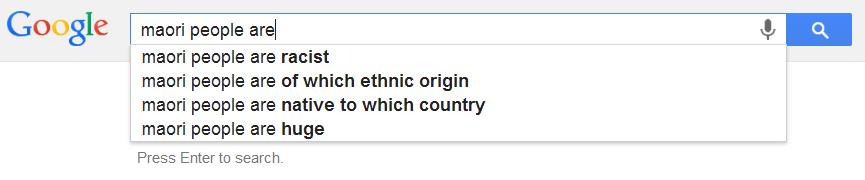




From May 2010


Google Translate Māori non representative
Google Translate is another example of AI, Algorithms and Machine Learning discriminating against minorities, while misrepresenting the Maori language and customs .
Google Translate interprets te reo Maori more accurately as it learns and is supporting the revival of te reo Māori. While it had the expertise of Dr Te Taka Keegan in its development, it still, as with other digital technologies reflects the fact that it is middle class, middle aged white men (Stale, Pale and Male) that dominate the industry, resulting in Google Translate of Māori language is chauvinistic and has no regard for LGBTQ+.
In the Māori language the word ‘ia’ is gender neutral and is used for any person of any gender whether majority gender or LGBTQ+. For further information I recommend reading Dr Elizabeth Kerekere Thesis “Part of The Whānau: The Emergence of Takatāpui Identity He Whāriki Takatāpui”
Māori traditional knowledge/epistemologies recognise all genders and did so before the western world acknowledged the term and that people were not binary gender based.
Below are a number of screen shots testing how Google Translate uses the gender neutral Māori word “ia” and decides, based on the scenario if it is a male or a female. Noting the chauvinistic system assigns a female translation to tasks such as cooking and sewing, emotions such as crying and being promiscuous. Male is assigned to most professions, trades, sports, leadership roles, humor etc. In addition to this sexist and chauvinistic translations are the fact that the LGBTQ+ communities are not considered, further reinforcing that AI, Algorithms and Machine Learning do discriminate against minority groups. In this instance, those technologies are discriminating against minority genders using the the Māori language as a vehicle to push such diatribe. The results appear to reflect a chauvinistic view that men work and have authority, while women less so and are more likely to do domestic chores.
My testing to get these results involved a number of different tenses, networks and IP addresses, but still with the same result.
Raising awareness using ia in pronoun email signatures
Te Kawa Mataaho Public Service Commission promote the use of pronouns in email signatures as a part of their commitment to Diversity and Inclusion.
If we all add ‘ia’ to our pronoun email signature, it could be seen as a passive way to raise awareness of this discrimination.
Solution
If consultation with out the community is not feasible or possible; I would suggest that it would appear that the best solution to this would be to translate the gender neutral Māori word “ia” into English as (she/he/they). By not doing so is allowing te reo Māori to continue to allow the English language and culture to continue the linguistic imperialism of the Māori language.
Screen Shots
Figure 1.
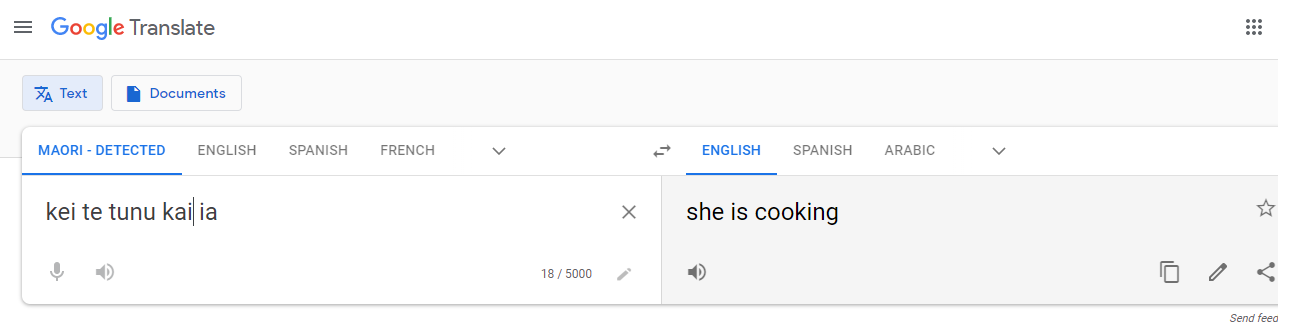
Figure 2.
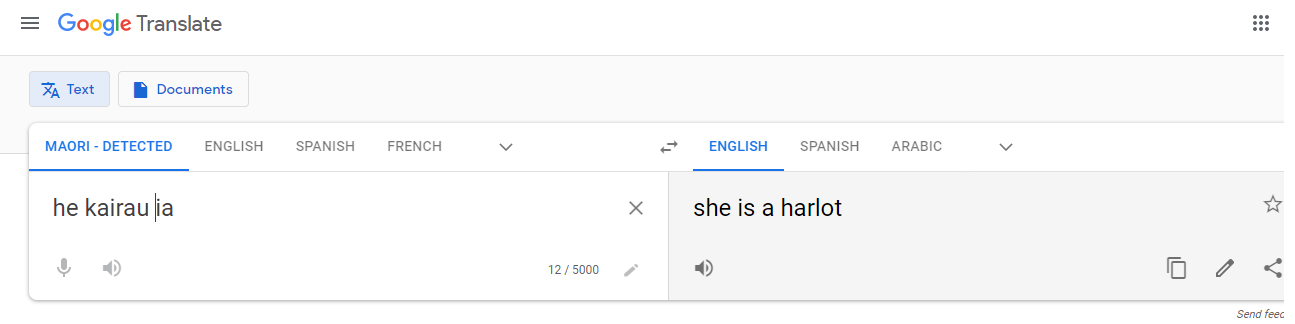
Figure 3.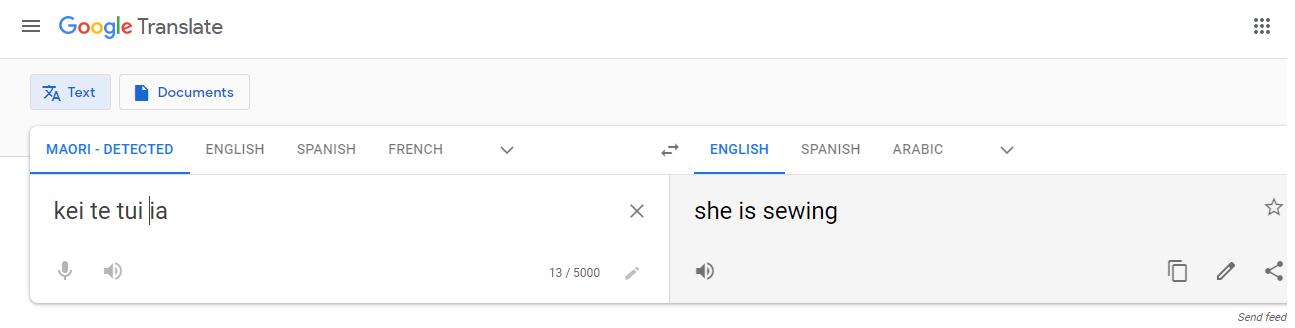
Figure4.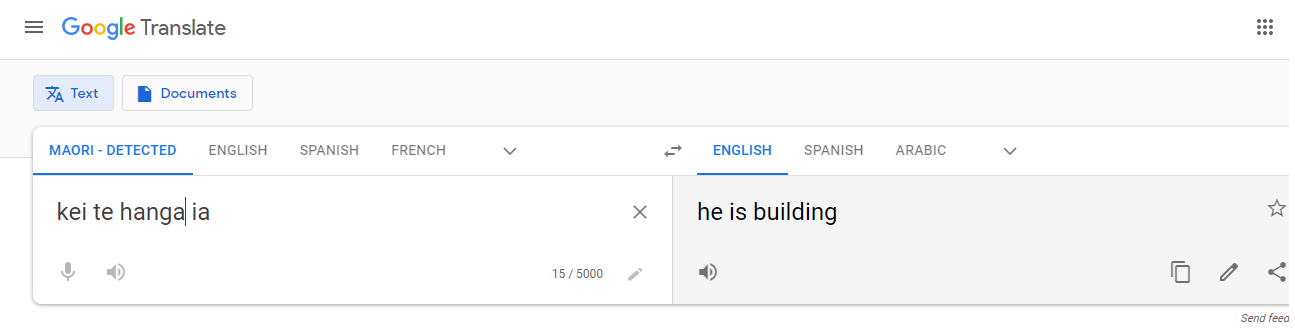
Figure 5. 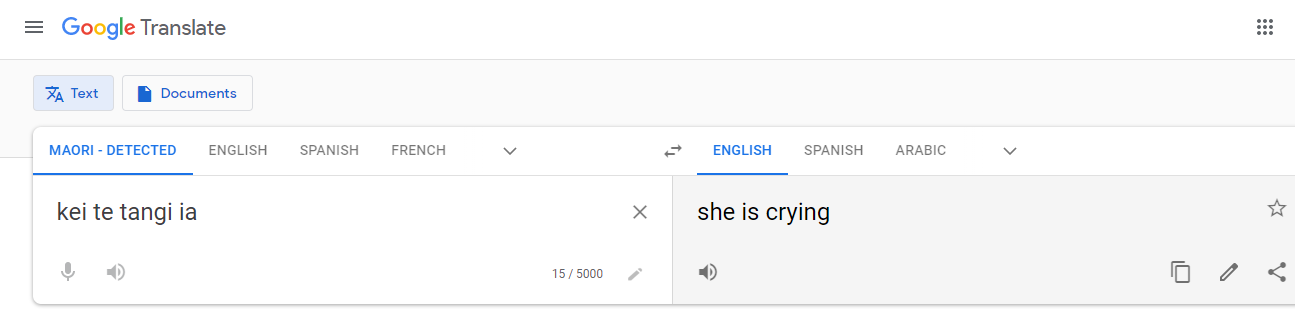
Figure 6.
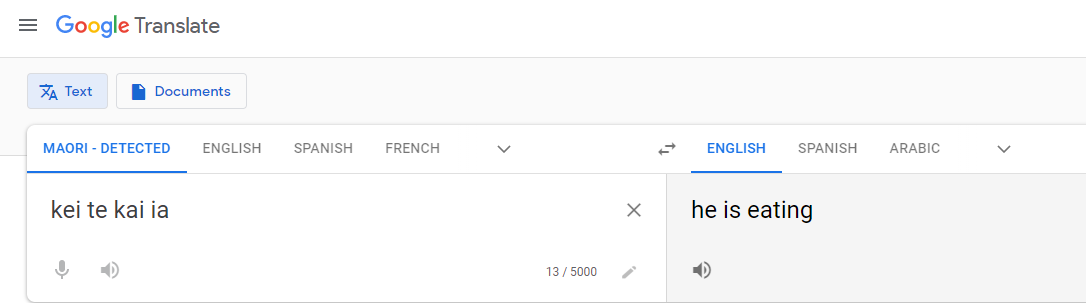
Figure 7.
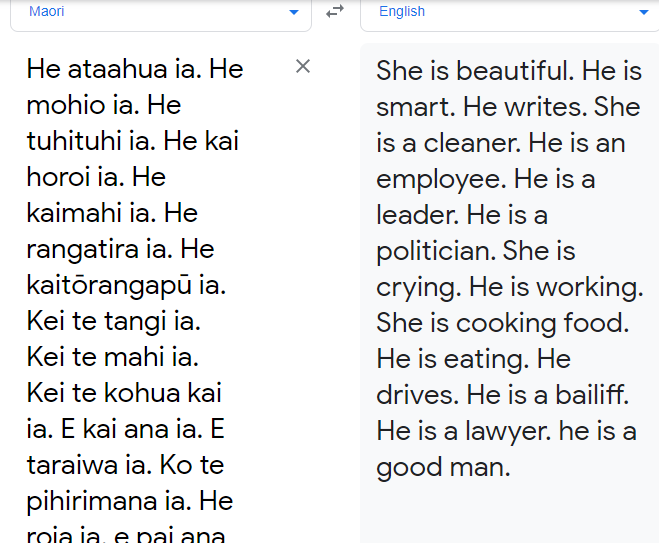
Figure 8.

NZ society’s stereotype of Māori people
September 21, 2016
The media article on the blunder of using Google translate by a mayoral candidate created lots of social media discussions that focused only on the tool and its te reo Māori issues and not the subtle racism in the story.
In summary: Hamilton mayoral candidate James Casson wanted to appeal to Māori voters and thought that the way to do this was by offering his candidate statement in the Māori language. So he asked a staff member to translate the document. That staff member used Google Translate which is still in development stage. The automated translation was not comprehensible.
First mistake James Casson made was that he has no idea of Māori culture and thought that simply having a translated version of his statement would suffice to win Māori voters.
But the most disturbing issue that reflects a popular New Zealand stereotype is in the article where James Casson states that:
“he gave his English version to a “Maori woman” at his office to get it done.”
Why did James Casson think that a Māori woman in his office could speak Māori? Would he have given it to a non Māori person to translate? His statement could also be taken as sexist as he didn’t simply say a staff member.
This stereotype is a common issue in New Zealand society where anyone who is of Māori descent is automatically assumed to be an expert in all things Māori, as if Māori have superior genes that make us know everything about the Māori language, customs and society. Yet we would not expect someone of Irish or other nationality to be an expert on their heritage, it is just a Māori thing.
The pressure is extremely high for many Māori who are placed in this situation in the work place and in social situation. Often I have seen organisations put all of their trust and visions for Māori into a Māori staff member who was never raised Māori and never learnt about Māoridom.
There are generations of Māori who were raised to believe that being Māori was shameful and to adapt and fit into society it is best to ignore your Māori heritage. There are also Māori who have witness’s things in their own families and community that makes them identify with being non Māori despite what their physical appearance may be.
According to statistics NZ between 1996 and 2013, the proportion of the Māori population able to converse in Māori decreased from 25.0 percent to 21.3 percent. I extrapolate that this is on the higher end of the real stats as people may have included being conversational when they are familiar with some Maori words and maybe a few sentences.
Google Aotearoa in Your Local Domain
The latest Google Doodle competition that recently announced the finalists provoked an old thought regarding the Google Aotearoa logo for the Visit Google’s Site in “Your Local Domain” page where Aotearoa is not shown in the listings.
The Google Wiki tool for Google Aotearoa is also in English much to my surprise. But I am glad that the original term Google Māori was changed to Google Aotearoa. This better reflects the bi lingual country we live in.
Regarding the Google “Your Local Domain” pages which has every country and its Google homepage with a link and its representative flag. Aotearoa is not in the list. But if it were in the list which flag would be used ?. The Tino Rangatiratanga flag has been strongly suggested as the default Māori flag to commemorate Waitangi issues such as being flown on the Auckland Harbour Bridge. But it is not the national Māori flag and with many tribal groups having their own flag such as Tuhoe, Tuwharetoa and Ngāi Tahu.
Perhaps in this time of globalisation and multilingualism/localisation, Aotearoa/New Zealand should consider a new flag that can represent Aotearoa ?. After all, Māori does have the “mi” language code assigned to it and is quickly becoming an international language on the Internet.
While i am writing about Google Aotearoa, if you are able please sign up to a Google account and help the public translation process complete the Google site.
Google Translate Toolkit Māori language
October 15, 2009
Google announced today. It was made possible by Dr Te Taka Keegan of the University of Waikato while on secondment to Google. Google Translate Toolkit is a translation tool that is edited by humans not automated by computers such as Google Translate.
Google Toolkit relies on the community to add words and translations. It then stores these translations and uses them for future translations. For example if a familiar sentence is offered for translation, the Google Toolkit will be able to translate it based on its memory of the sentence.
At the moment Google Toolkit appears to have very minimal input for Māori language. I could not seek an automated translation on several basic documents and web sites including Google own media release about supporting Māori.
People with word lists, and electronic dictionaries can upload their resources to the Google Toolkit to grow the Māori corpus. I encourage anyone who has such resources to do so. If you are technically unable to do so, please contact me and I will prepare the material for you.
Docs, html, web sites and pdf files can be translated via Google Toolkit.
Once translations are made they can be stored in a public file for public suggestions. These suggestions can then be edited to correct mistakes, add macrons or grammar.
The benefit of Google Toolkit would be that when more translations and corpus are added to the Google Toolkit the more quickly we could have documents translated into te reo Māori on the fly.
We are finally one step closer to automated Māori translations. A dream that for so long was only a dream.
Automated Google Māori translations
Google recently announced its support for several minority languages to translate into and from English with Māori being one of the minority languages.
To use the translator visit http://translate.google.com
For years a computer generated system to translate to and from te reo Māori has only been a dream and one that most people never expected to occur.
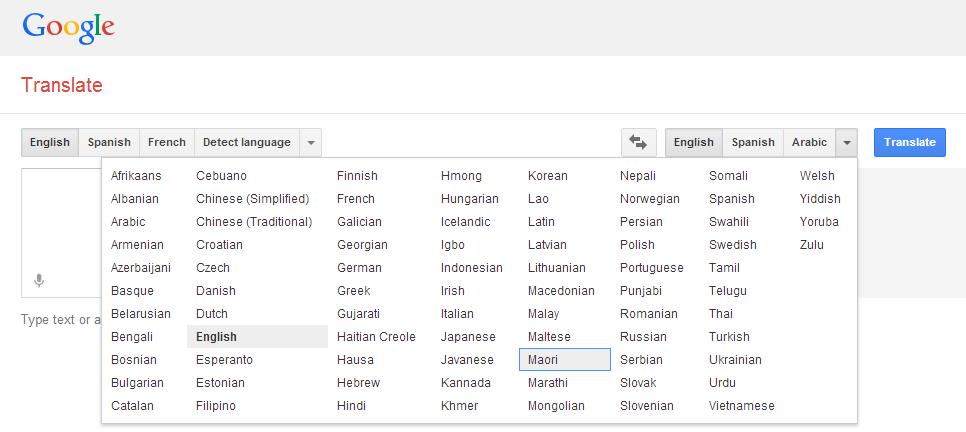
Google Translate will translate from Māori to English and English to Māori. To translate from English to Māori:
- On the right hand side of the screen click on the down arrow button
- Select “Maori”
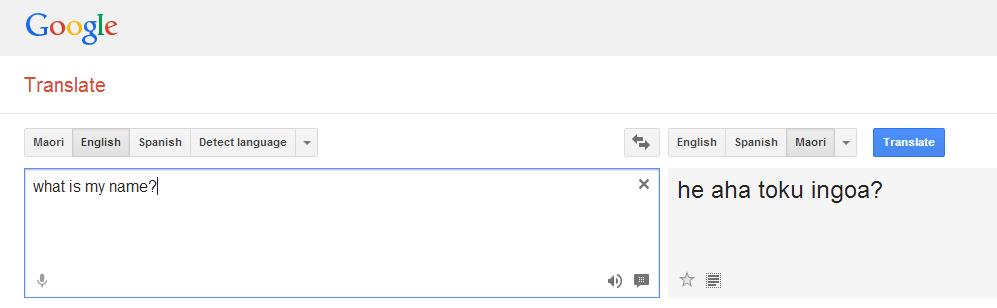
- Type the English sentences into the text area
- Output translation will appear in the right hand of the screen.
Māori speakers required to improve translations.
The Translator is still in its infancy and does require fluent speakers to rate various translations that will be used to improve the algorithms of the system. Anyone can do this without the need to register or log in. Simply visit http://translate.google.com
The translations are mediocre and often do not have macrons, but nevertheless the system works well for an early system.
1 thought on “Google”