
This post is part of Māori and Technology: What Figure.NZ Data Shows.
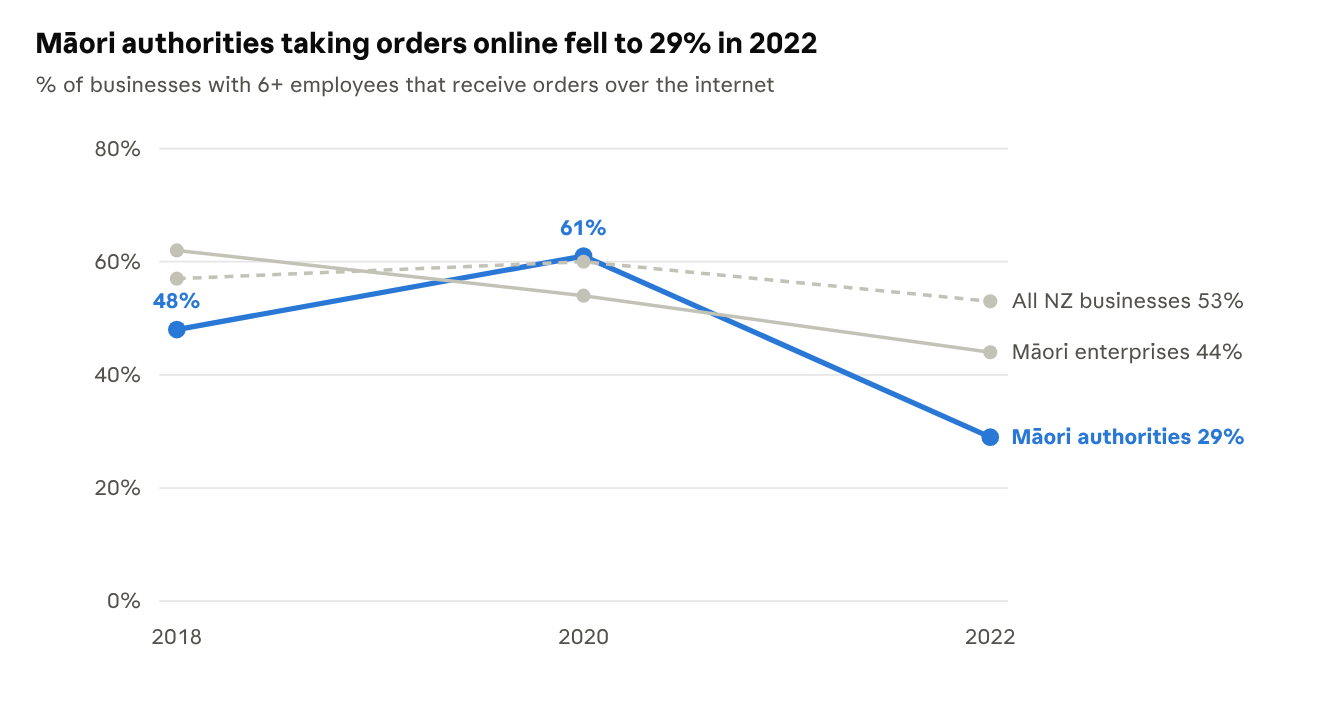
Māori businesses are as connected as other businesses, and Māori enterprises are as visible online and more likely to plan digital investment. Māori authorities lag: fewer have a web presence (65% vs 76% in 2022), and they have pulled back from selling online. The share of Māori authorities receiving orders over the internet fell from 61% in 2020 to 29% in 2022.
| Measure, 2022 (% of businesses with 6+ employees) | Māori authorities | Māori enterprises | All NZ businesses |
|---|---|---|---|
| Uses the internet | 97% | 98% | 96% |
| Has a web presence | 65% | 76% | 76% |
| Has a social media presence | 65% | 76% | 59% |
| Uses social media to recruit staff | 62% | 65% | 53% |
| Uses social media to collaborate with partners | 43% | 25% | 18% |
| ICT attack caused loss or damage | 6% | 6% | 6% |
Nearly all Māori businesses use the internet: 97–98% in every year from 2018 to 2022, slightly above all NZ businesses. So the fall in online orders among Māori authorities is not explained by a lack of internet access.
In 2018, ICT attacks hit Māori businesses harder: 19% of Māori authorities and 21% of Māori enterprises reported loss or damage, against 15% of all businesses. An older series, for businesses with internet access, shows Māori tourism businesses taking orders online at 71–80% from 2012 to 2018.
Among Māori businesses that do sell online, more made a large share of their sales online in 2018 than in 2012. For Māori small and medium-sized enterprises, the share whose internet sales were more than 10% of total sales rose from 9% to 49%. The figure for Māori tourism businesses was 79% in 2018. The authority and tourism figures rest on small numbers and some values are confidential, so treat year-to-year swings with caution.
Digital technology and climate change
Māori enterprises are more ready than other businesses to invest in digital technology, but report more barriers. In 2021, 32% planned to invest in new software or digital technologies over the next five years, against 25% of all businesses. Yet 14% cited the risks of adopting new technologies as a barrier to climate-related investment, against 6% of all businesses. Another 15% cited a lack of suitable staff or skills, against 11%.
Digital technology also features in climate responses. In 2021, 12% of Māori enterprises and 9% of Māori authorities had increased their use of digital technologies in response to climate change, against 10% of all businesses. Over the next five years, 19% of Māori enterprises and 20% of Māori authorities planned to, against 17%.
Commentary
The fall in online orders among Māori authorities is the most striking business result. Because their internet use stayed at 97%, the cause is more likely what many authorities do, managing land-based and collective assets where online ordering matters less, or swings in a small sample, than a digital divide.
Māori enterprises plan more digital investment but report more concern about technology risk and skills. That points to demand for trusted digital advice and skills support delivered in a kaupapa Māori way.
Their higher exposure to ICT attacks in 2018 also shows the need for cybersecurity support for Māori organisations that hold collective assets and whānau data.
Sources
- Māori Business – ICT activities by business type 2018–2022 (Stats NZ, via Figure.NZ, table)
- Māori Business – Internet sales by enterprise type 2012–2018 (Stats NZ, via Figure.NZ, table)
- Māori businesses which receive orders over the Internet, by enterprise type, 2018–2022 (Stats NZ, via Figure.NZ)
- Māori businesses with a web presence, by enterprise type, 2018–2022 (via Figure.NZ)
- Māori businesses which experienced ICT attacks that resulted in loss or damage, by enterprise type, 2018–2022 (Stats NZ, via Figure.NZ)
- Reasons Māori authorities have a social media presence, 2022 (Stats NZ, via Figure.NZ)
- Reasons Māori enterprises have a social media presence, 2022 (Stats NZ, via Figure.NZ)
- Reasons New Zealand businesses have a social media presence, 2022 (Stats NZ, via Figure.NZ)
- Māori authorities using the Internet to receive orders, 2012–2018 (Stats NZ, via Figure.NZ)
- Māori small and medium-sized enterprises using the Internet to receive orders, 2012–2018 (Stats NZ, via Figure.NZ)
- Māori tourism businesses using the Internet to receive orders, 2012–2018 (Stats NZ, via Figure.NZ)
- Investments businesses are planning to make in the next five years, by enterprise type, 2021 (Stats NZ, via Figure.NZ)
- Actions businesses undertook in the last two years in response to climate change, by enterprise type, 2021 (Stats NZ, via Figure.NZ)
- Actions businesses are planning to do in response to climate change, by enterprise type, 2021 (Stats NZ, via Figure.NZ)
- Barriers for businesses not making climate change-related investments, by enterprise type, 2021 (Stats NZ, via Figure.NZ)
Previous: Remote work · Back to Māori and Technology
How to cite this page
Taiuru, K.N. (2026, November 23). Maori and technology business. Taiuru & Associates Ltd. https://www.taiuru.co.nz/maori-and-technology-business/