Note: This article was first prepared for offline presentations when the reports it discusses were released. It has since been updated and published online on the date shown.
Māori teachers in primary schools are using generative AI to teach te reo Māori and tikanga more than their non-Māori colleagues. Yet most teachers do not know whether their school’s AI policy considers Te Tiriti o Waitangi or Māori Data Sovereignty, and 60% of the teachers using AI for te reo Māori say it is not always accurate.
These findings come from the New Zealand Council for Educational Research (NZCER) report Generative artificial intelligence in Aotearoa New Zealand primary schools: Teacher and student survey findings, released in August 2025. The report surveyed 266 teachers in late 2024 and 147 students across four case study schools. This post pulls out the Māori-specific results, which have received little attention since the report was released.
Māori teachers are leading
Māori teachers were significantly more likely than non-Māori teachers to use generative AI to teach te reo Māori and tikanga or mātauranga Māori. They made up 15% (23 of 149) of teachers who answered the ethnicity question.
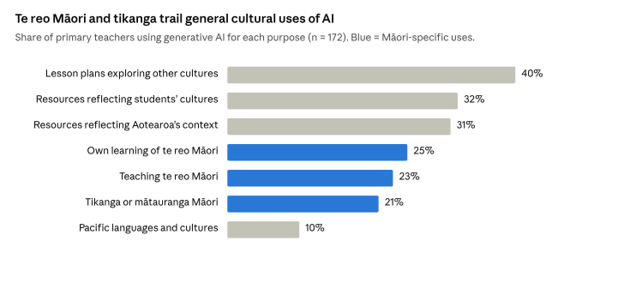
Across all teachers, 70% used AI for at least one culturally responsive purpose. Uses specific to te reo Māori and tikanga sit below general cultural content:
Te reo Māori: used, but not trusted
Of the 65 teachers who used generative AI for te reo Māori or tikanga and mātauranga Māori:
- 60% agreed AI tools do not always provide accurate information about te reo Māori.
- 51% did not feel confident detecting te reo Māori inaccuracies; only 27% did.
- 42% said AI had improved their ability to bring te reo Māori into their teaching; 45% were neutral and 14% disagreed.
This is the most concerning finding in the report. Half the teachers using AI for te reo Māori cannot reliably tell when it is wrong, so errors in reo, macrons, dialect and meaning are likely reaching tamariki unchecked.
The wider sample shows the same pattern. A third (33%) of teachers had seen cultural biases or inaccuracies in AI content, almost half reported problems with tools not customised for Aotearoa, and one teacher wrote that “some content does not reflect New Zealand or te ao Māori correctly”.
Te Tiriti and Māori Data Sovereignty: “I don’t know”
Most schools have no AI policy at all. Only 8% of teachers said their school had a teacher AI policy and 14% a student AI policy; 47% said there was no teacher policy.
The 65 teachers whose school had, or was developing, a policy were asked whether it considered Te Tiriti o Waitangi and Māori Data Sovereignty:
| Policy considers… | Agree | Disagree | Don’t know |
|---|---|---|---|
| Te Tiriti o Waitangi | 28% | 8% | 65% |
| Māori Data Sovereignty | 24% | 14% | 62% |
Two thirds of teachers do not know whether the policy they work under meets Te Tiriti obligations or protects Māori data. Only about a quarter could say Te Tiriti or Māori Data Sovereignty had been considered. Meanwhile 63% of teachers had never viewed the Ministry of Education’s generative AI guidance.
Tamariki are learning about Māori culture from AI
Among students who used AI, between 7% and 24% across the four case study schools said they had used it to learn about Māori words, stories or culture. Between 39% and 76% were unsure whether AI always understands or respects all cultures.
Tamariki are already asking AI about te ao Māori, and most cannot judge whether the answers respect it. The report does not break student results down by ethnicity, so we cannot see how Māori students themselves experience these tools.
What this means for Māori
The findings show Māori teachers carrying the cultural load of AI in schools, with tools that get te reo Māori wrong and no system support behind them.
Where Te Tiriti and Māori Data Sovereignty appear in school AI policy at all, most teachers cannot tell. That is the difference between architecture and decoration. A provision nobody can identify is not shaping how AI is used in the classroom.
73% of teachers said their school provides no premium AI access, so most are using free chatbots such as ChatGPT and Gemini. When teachers enter te reo Māori, pūrākau, pepeha or information about tamariki into these tools, that Māori data leaves Aotearoa under overseas terms.
The Waitangi Tribunal’s WAI 2522 report is clear that the Crown must actively protect Māori interests in data. School boards are Crown entities, and “we didn’t know” is not active protection.
Inaccurate reo is a harm, not a glitch. Te reo Māori is a taonga. When half the teachers using AI for reo cannot detect its errors, AI becomes a channel for teaching tamariki incorrect reo at scale.
These results also match the Te Ao Māori News poll I wrote about recently, where rangatahi Māori raised concerns at the lack of AI training. The gap starts in primary school.
Recommendations
NZCER recommends professional learning co-designed with iwi, school and national policies that address Te Tiriti and Māori Data Sovereignty, and AI tools suited to Aotearoa. I support all three. To make them operative rather than decorative:
- Ministry of Education: issue a model school AI policy with Te Tiriti and Māori Data Sovereignty clauses that boards must adopt or explain, rather than leaving each school to work it out.
- School boards: tell staff in plain language what the policy says about Māori data, and ban entering identifiable information about tamariki or whakapapa into free, offshore AI tools.
- Teachers: treat AI-generated te reo Māori as a draft to be checked by a fluent speaker, never as a finished resource.
- Iwi and hapū: be resourced to decide how their reo, mātauranga and kōrero are used with AI in local schools. Tino rangatiratanga sits with them, not with a national body.
- NZCER and the Ministry: report student results by ethnicity in future surveys, and fund a Māori-specific study with a larger sample than 23 Māori teachers.
Schools can use the He Tangata, He Karetao, He Ātārangi framework to assess whether an AI tool is suitable to use with te reo Māori and mātauranga Māori.
A caution on the data: respondents were self-selected and more interested in AI than average, and only 23 of 149 teachers who answered the ethnicity question were Māori. The report gives significance results for Māori comparisons but not the underlying percentages.
References
Coblentz, D., Dong, J., & Gibbs, B. (2025). Generative artificial intelligence in Aotearoa New Zealand primary schools: Teacher and student survey findings. New Zealand Council for Educational Research. https://doi.org/10.18296/rep.0077
Taiuru, K. (2026, October 27). Rangatahi Māori concerned with lack of AI training. Taiuru & Associates. https://www.taiuru.co.nz/rangatahi-maori-concerned-with-ai-training/
Taiuru, K. (2026). He Tangata, He Karetao, He Ātārangi: Kaupapa Māori AI framework. Taiuru & Associates. https://www.taiuru.co.nz/kaupapa-maori-ai-framework/
Waitangi Tribunal. (2021). The report on the Comprehensive and Progressive Agreement for Trans-Pacific Partnership (Wai 2522). Legislation Direct.
How to cite this page
Taiuru, K. (2026, November 2). Maori and Generative AI in Primary Schools 2025. Taiuru & Associates Ltd. https://www.taiuru.co.nz/maori-and-generative-ai-in-primary-schools/